
Case Study: A Unique Specialist Calibration Laboratory uses Document Manager
Tucked away in a hillside, you’ll find one of the world’s most specialised laboratories working in density metrology – an extraordinarily niche field. For nearly four decades, this specialist laboratory has built its reputation on trying to achieve the best possible precision. It provides calibration and consultancy services that involve everything from food production and petrochemicals to fine spirits and transformer oils.
With 92% of the laboratory’s work exported to over 40 countries in a year, it isn’t just a UK success story – it’s become an international reference point for density measurement.
But here’s the thing: while the scientific side needs laboratory instruments of exceptional sensitivity and accuracy, there’s an equally critical element working behind the scenes. That’s the management, security and accessibility of data and documentation.
This is where Document Logistix’s Document Manager comes in. It’s become a cornerstone of the laboratory’s operations and has completely transformed how it handles compliance, record-keeping and day-to-day efficiency.
What is Density Metrology – and Why Does it Matter?
Density metrology is the science of measuring density with exactitude. Density – the relationship between mass and volume – is one of the most fundamental properties of matter. Knowledge of the density can help to understand how liquids flow, how solids behave under stress, how fuels burn, and how food and drink get sold.
For industries, the implications are huge. A refinery needs to know the precise density of petroleum products to guarantee specification. Manufacturers of transformer oils rely on density measurements to prove authenticity and quality, which is especially important given the circulation of counterfeit oils in some markets.
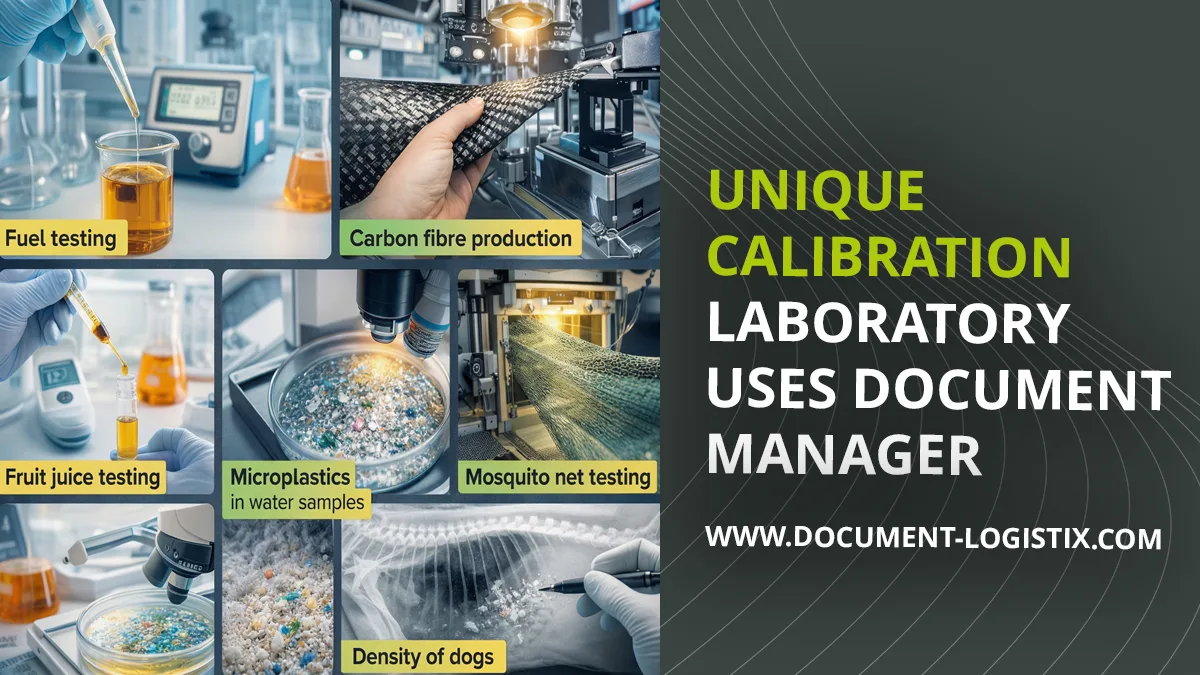
Density metrology is crucial to ensure the efficacy of a vast range of clinical, healthcare and other vital products and processes. The list includes vaccine production, use of carbon fibre in aeroplane construction, the manufacture of heart valves, non-stick frying pan lining, checking that planes have enough jet fuel on board for ocean crossings, fruit juice testing, and guarding against poor quality mosquito nets.
Density measurement also ties into regulation and consumer protection. In food production, manufacturers may fill their cartons by volume, while retailers sell them by weight. This creates a conversion challenge – and without precise density measurements, discrepancies can build up and lead to financial loss or legal disputes.
The laboratory offers a remarkable range of density-related services to support these industries:
- Liquid density standards for calibrating density meters
- Density gradient column floats and fillers which are essential for laboratory testing during plastics production
- Calibration of density meters and hydrometers which are vital instruments in countless sectors
- The Alcofloat spirit test kit which is a deceptively simple device that helps customs officials and bars detect whether “over the counter” spirits have been watered down
- Expert consultancy to provide guidance on all aspects of density measurement.
What makes the laboratory unique isn’t just its breadth of expertise but also its accreditation and reputation.
The Role of ISO17025 Accreditation
In the world of measurement, traceability and accreditation are everything. In the UK, the British accreditation authority is the sole national body recognised by government to assess organisations against internationally agreed standards.
ISO 17025 “General requirements for the competence of testing and calibration laboratories” lays down the requirements that accredited laboratories must follow. For the specialist calibration or testing laboratory, ISO17025 accreditation gives assurance that its results are robust and reproducible. By international agreement, if a lab in one country is accredited to ISO17025, their certificates will be accepted in most other countries.
But the authority imposes strict requirements – particularly around documentation. Every measurement, every calibration and every certificate must be archived securely to protect against tampering, and must potentially be retrievable decades after it was first produced. Records aren’t just administrative by-products – they’re the backbone of compliance, accountability and trust.
One of the laboratory’s first challenges was how to store and organise documents effectively. They needed something that would make everyday operations more efficient and help to meet the 17025 requirements. The laboratory’s in-house systems were struggling under the weight of accumulated research papers, certificates, records and consultancy reports.
The Turning Point: From Struggling In-House Systems to Document Manager
The solution came with Document Logistix’s Document Manager – a document management system designed to give organisations complete control over their records. From document creation and storage to retrieval and audit.
For the laboratory, the first key requirement was that Document Manager could be installed locally rather than relying on cloud infrastructure. In a field in which data security and confidentiality are crucial, local installation offered reassurance that sensitive records would remain under the laboratory’s control, rather than sitting in a server farm managed by a third-party provider.
On-premises installation also addressed concerns about accessibility. With a local installation, the laboratory’s scientists and administrators could access the system directly and immediately, which is essential when working in a complex, fast-moving laboratory environment n which time is often critical.
From Siloed Data to Full Traceability
The shift to Document Manager marked a significant operational change. Gone were the days of scrolling through old server directories. Instead, the company now had:
- Document Indexing and Instant search and retrieval
With full OCR (optical character recognition), automated indexing and free text search capabilities, even obscure technical papers in their vast library could be stored and located in seconds. - Audit trails
Document Manager records the complete lifecycle of a document – from creation through every viewing, amendment and signature. For 17025 compliance this audit trail is invaluable. It enables the laboratory to provide evidence of accountability that regulators and clients alike can trust. - Read-only rendering
Once a certificate is finalised, Document Manager can render it read-only to eliminate the risk of accidental or malicious alteration. - Performance mapping
By comparing historical records with current ones, the laboratory can chart trends, highlight improvements and track consistency over decades of measurement.
Streamlined Workflows Ensure Operational Efficiency
Beyond compliance and record-keeping, the laboratory also uses Document Manager’s workflow functionality to streamline day-to-day operations. For procurement, every item the laboratory buys – whether specialist glassware, chemicals or precision instruments – goes through a controlled workflow.
Purchase requisitions, approvals and supplier invoices are tracked, signed off and systematically archived. Customer purchase orders for the laboratory’s own products and services go through the same process, with Document Manager providing a transparent and auditable trail from order receipt to delivery and invoicing.
By automating these processes, the laboratory has reduced administrative delays and improved accuracy, and ensured that every transaction is documented.
The workflow also plays a key role in managing instruments sent to the laboratory for calibration. Each instrument is logged on arrival, linked to the customer’s documentation and tracked through the calibration process. Certificates, service notes and return shipping records are automatically attached to the workflow so nothing is missed and customers receive their instruments and documentation without delay.
This structured approach not only supports ISO17025 but also gives customers peace of mind that their instruments and data are being handled with the same rigour and precision as the laboratory’s scientific measurements.
Accuracy, Reliability and the Human Dimension
If there’s a single word that defines the calibration laboratory’s work, it’s accuracy.
Whether the laboratory is calibrating a hydrometer for a distillery in Scotland, verifying the density of transformer oils for an energy supplier in Asia, or investigating unusual cases, accuracy is the bedrock of the laboratory’s service.
Of course, accuracy can’t be separated from documentation. A measurement without a properly secured, retrievable certificate is meaningless in regulatory terms. Reliability demands not only scientific precision but also documentary traceability.
The staff at the laboratory understand this completely. Laboratory scientists depend on being able to reference past data. Administrators value Document Manager’s search capabilities when they need to locate supporting references and papers.
Clients in over a hundred different countries expect certificates to be delivered promptly and with the guarantee that records will be available years later if ever required for audit, or in the event of dispute.
Without a robust document management system, the risk of misfiling, duplication or data loss could undermine the very foundation of the laboratory’s reputation.
Ampoules Help to Preserve Standards
Another important aspect of the laboratory’s work is preparing and long-term storage of sealed ampoules of liquid density standards. These ampoules can be requested in batches by clients over extended periods to ensure continuity and consistency in calibration work. By drawing from certified production batches, laboratories across the world can remove uncertainty that might arise from variations between different instruments
In practice, this means that a distillery, a petrochemical plant or a government agency can rely on perfectly traceable density references for years. They can be confident that every ampoule they order has a documented lineage back to System Internationale / SI units.
This careful approach reflects the company’s philosophy: traceability requires a chain of evidence that must be preserved and accessible over time – a chain that Document Manager helps to safeguard at every step.
Beyond Compliance: A System that Creates Operational Advantages
What has surprised the laboratory is how much Document Manager has gone beyond simply satisfying regulatory requirements. The system helps the laboratory stand out and gives it measurable advantages. Clients appreciate the speed with which the company can retrieve historical records. Regulators use the audit trails when carrying out inspections. Staff feel freed from the burden of administrative inefficiency.
The consultancy arm of the company has found that having immediate access to decades of technical papers enhances their advisory services. They can draw upon a living library of knowledge – a collective memory – that gives clients confidence that they’re dealing with one of the deepest reservoirs of density expertise in the world.
Case Examples – Where Documentation Matters
- Distilleries
For whisky makers, ensuring that each bottle has the correct alcohol content isn’t just about brand integrity but also legal compliance. Certificates of density calibration provide that assurance. With Document Manager, those certificates are safeguarded for the long haul. - Counterfeit transformer oils
In the energy sector, fake transformer oils have caused catastrophic failures. Density testing exposes the fraud, but the chain of documentation is equally critical – a case could collapse in court without demonstrably secure records. - Unusual investigations
The laboratory has been called upon for unusual cases, such as advising on how to measure the density of dogs for a veterinary college or exploding plastic collection boxes on lawn mowers – many plastic shards do not show up on X-rays. They provide equipment to measure the density of oceanographic samples, be they krill, fish eggs or microplastics. These might sound eccentric, but they highlight the breadth of density metrology – and the necessity of keeping well-documented reports that can be revisited when unexpected queries arise.
Conclusion: Documenting Precision
At the specialist testing laboratory, accuracy isn’t just an aspiration but a contractual obligation. The company’s ISO17025 accreditation and its global client base depend upon its ability to deliver test results that are precise, reliable and demonstrably traceable.
By adopting Document Logistix’s Document Manager, the laboratory has turned what was once a vulnerability – document storage and retrieval – into a strength. The system has provided secure, long-term record-keeping, rapid search and retrieval capabilities, comprehensive audit trails and protection against error.
For a company working at the cutting edge of scientific precision, these aren’t optional extras but vital tools that underpin the laboratory’s credibility.
Perhaps most tellingly, the staff at the laboratory don’t talk about the system in jargon-heavy terms. They simply say of Document Manager: “It makes it easy to find stuff.”
When you’re in the business of world-leading density measurement, sometimes simplicity is the clearest measure of success.