Document Management Software for Manufacturing
With Digital Workflow Automation
Talk to Document Logistix about manufacturing document management to improve workflow, production, business intelligence, compliance and profits.
Document Management Software for Manufacturing
Document management software for manufacturing solves many production, process and compliance issues. As a manufacturer, do you face these information management issues?
- Is document automation in your manufacturing processes simple to achieve?
- Can you feed back into the manufacturing process quickly a delay or change to an order or request from the customer?
- Can Team Managers report to management to avoid delays in payment that might affect cash flow?
- Does document control enable management to view how efficiently processes and teams are working?
- Are resources balanced at the correct points in the process?
- Is regulatory compliance built-in to your manufacturing workflow system and assured?
A Gartner report suggests that “leaders must drive companies to become more agile and insight-driven as products, markets, regulations, tracability requirements and customer needs evolve at an increasingly rapid pace.”
The challenges facing CIOs and technology-centric leaders of manufacturing operations include two that involve strategic document management.
- Profitable customer engagement
How can manufacturers gain more insight and improve decision making? How can manufacturers improve collaboration with their partners in the supply chain? - Product life cycle excellence
What practices should manufacturers adopt for continuous product innovation and PLM discipline? How do manufacturers remain agile in procurement, production and product strategies?
Manufacturing Output UK and USA
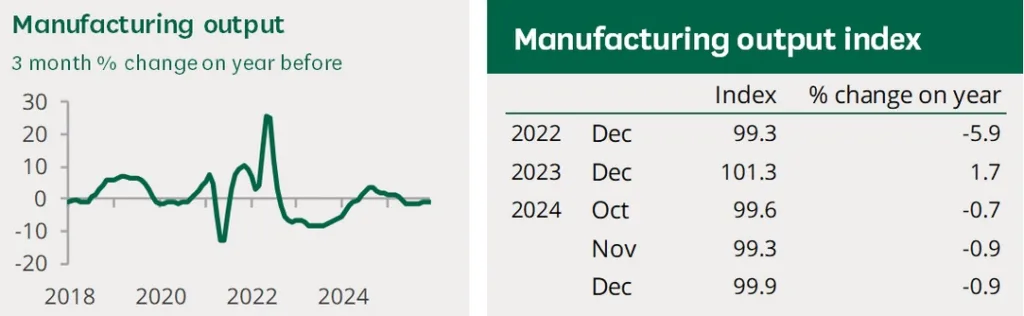
Make UK’s annual analysis of manufacturing facts and statistics for 2023 revealed a significant jump in manufacturing output to £224 billion, which places the UK 8th in global manufacturing rankings.
In 2023, the U.S. manufacturing economy contributed $2.3 trillion to U.S. GDP which amounted to 10.2 % of total U.S. GDP, according to BEA data.
The leading manufacturing sectors in the UK are food and drink, transport (notably aerospace and automotive), chemicals, life sciences and metals. In the USA, leading sectors include chemical products; food, beverage and tobacco products; and computer and electronic products.
Any commentary on the manufacturing sector, emphasises the pressures of competition, both within countries and globally among manufacturing powerhouses that include China, South Korea, Germany and Japan.

Global Economy Pressure on Production Methods
Global manufacturing competition is fierce, while, as indicated in the UK government’s latest figures, manufacturing output can fluctuate radically in a short space of time.
Where there is extreme competition in any industry, productivity levels and cost control are major factors that influence success or failure.
Where there is volatility in markets, agility plays a key role in a company’s ability to anticipate and adapt to prevailing conditions, and to flex to meet changes in supply conditions and demand.
In the case of productivity, document management in manufacturing can play an important role in helping companies to optimise both administrative and production processes. While, when it comes to business agility, document management in the manufacturing sector can play a key role in helping companies to flex to meet market conditions.
Document Control is Essential
The Document Management and RPA Product of the Year Document Manager enables manufacturers to control every aspect of document management. Our system combines data capture, enterprise search, automated workflows, permissions-based access and built-in compliance. Plus, a user-friendly dashboard.
Overcome Manufacturing Process Bottlenecks: BI and Automation
Our document management software for the manufacturing industry delivers a wide range of benefits to your business, your clients, your production team and your accounts team.
Processes are leaner and you can expect a return on investment within months of upgrading your systems.
Document Logistix can help you make the transition efficiently and effectively, and ensure that all documents, from CAD drawings and project documents to job sheets are securely stored, instantly accessible and available to all authorised stakeholders.
Core manufacturing document management workflow functions enable manufacturers to manage processes from orders in the supply chain, through production, to POD and billing.
Manufacturers’ workflow can be designed and automated to include agreed checkpoints assigned to owners for comment, approval or escalation.
The great advantage of digital systems for a manufacturing operation is that many aspects of the process can be automated, which increases efficiency throughout.
Document Management throughout a Product’s Lifecycle
Digital document management software for manufacturers helps to manage the complete lifecycle of products.
Product lifecycle milestones include:
- Customer order
- Design
- Component traceability
- Accreditation records
- Quotations
- Build, including time management
- Approval
- Completion
- Despatch
- Customer feedback
- Disposal
Document Compliance Management in Manufacturing
The requirement for document management software within manufacturing organisations is always attached to a need to be efficient while maintaining regulatory compliance.
Document Manager is sufficiently versatile to be applied throughout your business. From helping the finance department to process invoices, helping quality teams to manage global documents in the QMS, or implementing approval processes in Standard Operating Procedures.
Documents are encrypted and their retention periods are automated to meet strict compliance regulations.
See Product of the Year, Document Manager, in action.
How to meet your manufacturing process objectives >

How Simple is it to Implement Document Manager in my Manufacturing Set-up?
At Document Logistix, we’ve made implementing Document Manager as smooth as possible. It’s designed to integrate with your existing systems with minimal disruption. Our team guides you through setup, training and migration to ensure a seamless transition. You’ll need some IT involvement and key users for input, but we handle the heavy lifting, so you can focus on running your business.
Is Customisation an Option?
Absolutely! Document Manager is built to adapt to your manufacturing processes, workflows and terminology. We tailor metadata fields, templates and automation rules to fit your exact needs. Whether it’s industry-specific compliance requirements or unique approval chains, the system moulds to your way of working in order to boost efficiency without forcing you to change how you operate.
Is the Document Management System Scalable?
As your needs change or company grows, so does Document Manager. It’s built for scalability, i.e., to handle increasing document volumes, multiple locations and expanding teams with ease. Whether you’re adding users, going through a merger or acquisition, integrating with new software or expanding globally, the document management system keeps performance smooth and access seamless. No matter how big you get, Document Manager grows with you, which future-proofs your document management capabilities.
Q&A Manufacturing Document Management
Q1: What is manufacturing document management, and why is it important?
A: Manufacturing document management refers to the systematic organisation, storage and retrieval of all documents related to the manufacturing process, such as blueprints, work instructions, quality reports, compliance documents and machine manuals.
Manufacting document management is important because it ensures compliance with industry standards, improves operational efficiency, minimises errors and provides quick access to critical information needed for production and decision-making.
Q2: What are the common challenges faced in manufacturing document management?
A: Common challenges include:
- Version control issues
Ensuring the latest versions of documents are used. - Data silos
Lack of integration between document management systems and other enterprise systems. - Compliance risks
Meeting regulatory and quality standards. - Accessibility problems
Difficulty in retrieving documents quickly across departments or locations. - Manual errors
Human errors in document handling, filing, or updating.
Q3: How can a document management system (DMS) benefit manufacturing operations?
A: A DMS benefits manufacturing by:
- Streamlining the storage and retrieval of documents.
- Ensuring version control and reducing errors.
- Improving collaboration among teams with centralised document access.
- Enhancing compliance with automated audit trails and regulatory documentation.
- Increasing productivity by reducing time spent searching for information.
Q4: What features should a manufacturing document management system include?
A: A robust manufacturing DMS should include:
- Version control to track and manage updates to documents.
- Search and retrieval functionality for quick access to needed files.
- Integration capabilities to connect with ERP, MES and other systems.
- Compliance management to store and retrieve documentation for audits and certifications.
- Role-based access to ensure secure document handling and access permissions.
- Mobile and cloud access for remote access and real-time collaboration.
Why Manufacturing Inventory Management Matters
In manufacturing, inventory extends beyond finished products and includes raw materials, components and work-in-progress (WIP) items. Mismanagement can lead to excess inventory, stockouts, disrupted production or inflated costs. A robust inventory management system mitigates these risks by providing real-time insights into stock levels, predicting demand and ensuring efficient allocation of resources.
Key Benefits of a Manufacturing Inventory Management System
- Improved Stock Accuracy
Accurate inventory tracking reduces the chance of discrepancies between physical stock and inventory records. An inventory management system ensures reliable data, reducing costly errors. - Demand Forecasting and Planning
Leveraging past data, an inventory system forecasts demand, helping manufacturers plan purchases, reduce lead times and prevent overstocking or understocking scenarios. - Enhanced Production Scheduling
Integrated systems coordinate inventory levels with production schedules, ensuring raw materials are available when needed and avoiding costly production delays. - Cost Reduction
By optimising inventory levels, businesses reduce storage costs, avoid over-purchasing and minimise wastage, directly impacting the bottom line. - Real-Time Data and Analytics
Access to up-to-date data helps businesses make quick, informed decisions, from restocking items to adjusting production schedules. - Regulatory Compliance
Certain industries require strict adherence to inventory tracking regulations. Automated inventory management systems make it easier to meet these regulatory demands.
Customer Engagement: The Cornerstone of Innovation
Customer engagement and early feedback on product quality are key to sustained manufacturing success.
Document Logistix manufacturing customers implement digital document and information capture processes to enable client services teams to interpret customer and consumer feedback.
The latest client research solutions provide semantic search capabilities and data modelling to support knowledge-based engineering and product innovation.
Document Management Integration with Manufacturing Systems
There are often other key systems and software in place when we talk with manufacturers about document management. These typically include ERP systems, and finance and quality management systems.
At Document Logistix, we place great importance on getting to know your current systems to ensure that we integrate with them, avoid disruption, and facilitate user adoption.
Document Manager integrates with all leading systems to facilitate data centralisation to make documents instantly accessible.
Users can search, view and amend documents in a single system without to exit and search for them elsewhere.
Systems Deployment
Today, even though their premises may be brick and mortar, manufacturers have to be agile and use every advantage at their disposal.
Staff are likely to work across multiple company, partner or customer sites, so secure remote access is a preferred option.
Manufacturers can make choices about software, business processes and deployment.
Document Logistix offers a full range of deployment options, based on the precise needs of each customer.
Document Management for Manufacturing Works Across the Entire Organisation
Besides enhancing manufacturing processes, there are many other areas of the business that can be enhanced by digital document management systems, such as HR, Accounts, Procurement and Asset Management.
From HR records management (which may include anything from on-boarding documents to pension records) to vehicle or facilities management (which may include anything from insurance renewals to H&S statements), processes can be digitised and automated for maximum efficiency and demonstrable ROI.
Streamline Any Manufacturing Department
Manufacturers generate a constant stream of paperwork electronically or in paper form, for example: customer information, supplier information, materials information, staff records, general correspondence, invoices, contracts, health and safety and maintenance records, and receipts.
Regardless of format, the key to success is accurate information capture and secure storage that facilitate instant access and information management.
Manufacturers use Document Manager to digitise and index documents.
Note: there is no problem organising unstructured data.
Digital storage and document process automation help manufactuers to overcome process bottlenecks and deliver business efficiency that meets compliance requirements.
QA from Shop Floor to Senior Management
In manufacturing, the shop floor is where everything comes together – materials, machines and people working in sync. But without proper document integration, things can quickly go off track. Work instructions, SOPs and quality checklists need to be instantly available, up-to-date and accessible where they’re needed most. That’s why integrating document management directly with the shop floor is crucial.
With a system like Document Manager, operators, engineers and quality teams can pull up the latest specifications, track revisions and ensure compliance in real time. Automated workflows keep approvals moving, while audit trails make regulatory compliance effortless. No more chasing paperwork or risking outdated instructions – just smooth, efficient production with full quality control, traceability and compliance built right in.
While at board and senior management level, executives have management line-of-sight across critical manufacturing processes. Document Manager features advanced reporting and visual business intelligence dashboard to ensure that people in every role have the right information to be effective and optimally productive.
What is Efficiency in Manufacturing?
Efficiency in manufacturing isn’t just about working faster, it i sof course about working smarter.
Process optimisation eliminates bottlenecks to ensure every step, from design to delivery, flows seamlessly, all of which can be recorded in tracked in your document management software.
With automated workflows, approvals, document routing and version control happen instantly, which reduces human error and delays. Pre-configured, automated process protocols mean fewer production disruptions and result in a more efficient operation.
Real-time visibility takes it efficiency further, by giving teams instant access to critical documents, compliance records and production data. Managers can track progress, spot issues early and make informed decisions on the fly.
When automation and efficiency come together, manufacturing becomes leaner, more agile and fully optimised for success.
The Critical Role Document Management in Assuring Compliance
As Compliance Directors and DPOs know, in manufacturing, compliance isn’t optional – it’s critical. With strict regulatory requirements, manufacturers need to ensure every process, material and safety protocol meets industry standards.
Being audit-ready at all times is non-negotiable; when inspectors arrive, there can be no scramble for documents – the manufacturer needs instant, accurate access.
That’s where document management plays a vital role.
A digital document management system safeguards data integrity, and ensures that records are accurate, up-to-date and tamper-proof.
With secure access controls, version tracking and automated workflows, manufacturers stay compliant, reduce risk and maintain trust, because in manufacturing, compliance isn’t just about following rules, it’s about protecting the business.

Traceability Assured with Manufacturing Document Workflows
A document management system is critical for effective traceability management in manufacturing, Tracking the lifecycle and movement of documents and products is essential.
In traceability management, every step in a product’s journey, from raw material acquisition to final delivery, must be documented to ensure quality control, regulatory compliance, and transparency.
Document management software in manufacturing organises and stores information (e.g., invoices, production reports, certificates), to ensure that they are easily accessible, searchable and securely stored.
By automating the capture and retrieval of documents, document management software ensures that each phase of the product lifecycle is traceable.
Features like version control, time-stamped audit trails and metadata tagging enhance the ability to monitor changes, access and compliance history.
Built-in functions ensure that any discrepancies or issues can be traced back to the responsible document or process.
A DMS also enhances compliance with standards like ISO 9001 which requires robust traceability.
A DMS ensures that necessary documentation for product recalls, audits or customer enquiries is immediately available, which reduces risks and response times.
Digitise Paper Information
The majority of information enters a business in electronic formats, however, in manufacturing paper is still commonplace.
Most businesses aspire to going paperless, because paper is hard to track, costly to manage and has environmental implications.
Document Manager enables you to go paperless where you can, and to manage paper-based information efficiently and securely by digitising documents as they enter your business.
When required, Document Logistix helps customers to digitise legacy records quickly in our in-house scanning bureau.
Best Practices for Manufacturing Document Management
- Centralise Document Storage
Implement a unified document management system (DMS) that serves as a single source of truth for all manufacturing documents. - Ensure Robust Version Control
Use version control features to track updates and ensure only the latest versions of documents are in use, and maintain a clear audit trail. - Categorise and Index Documents
Organise documents using clear categories, metadata and tags, such as product type, department or project. - Integrate with Manufacturing Systems
Connect the document management system with ERP (Enterprise Resource Planning), MES (Manufacturing Execution Systems) and QMS (Quality Management Systems). Plus, enable seamless data exchange and document usage across systems. - Enforce Access Controls and Security
Use role-based access to ensure that only authorised personnel can view or edit certain documents, and protect sensitive information through encryption. - Automate Workflows
Automate document workflows, such as approvals, reviews, and distribution, to minimise delays and errors. - Ensure Compliance and Audit Readiness
Store all compliance-related documentation in an organised, auditable manner. - Support Digital and Mobile Access
Enable mobile access for teams working on the shop floor or remotely. - Train Employees
Provide training for employees on how to use the DMS effectively.
By following these best practices, manufacturers can enhance efficiency, improve compliance and reduce the risk of costly errors in their operations.
Essential Features of a Manufacturing Inventory Management System
To achieve operational efficiency, an inventory management system should offer these essential features:
- Inventory Tracking and Monitoring
Comprehensive tracking of raw materials, WIP items and finished goods across multiple locations. - Barcode and RFID Scanning
Barcode and RFID scanning capabilities streamline item identification and reduce the risk of manual entry errors. - Real-Time Inventory Updates
Real-time data on stock levels enables proactive responses to inventory shortages or surpluses. - Forecasting and Demand Planning
Predictive analytics help manufacturers anticipate future inventory needs based on historical trends, current demand and seasonality. - Order Management
A centralised order management feature simplifies purchasing, restocking and receiving processes, ensuring items are available as needed. - Integration with ERP and Other Systems
Integration with ERP, accounting and other systems facilitates seamless data flow across departments, improving overall productivity. - Work-in-Progress (WIP) Management
Tracking WIP items provides visibility into production processes, ensuring raw materials progress smoothly through the manufacturing stages. - Reporting and Analytics
Detailed reports and analytics offer insights into usage patterns, slow-moving inventory and profitability, helping manufacturers fine-tune their strategies. - Supplier Management
Effective supplier management features track supplier performance, lead times and costs, ensuring smooth replenishment and optimising vendor relationships.
Best Practices for Manufacturing Inventory Management
- Implement Cycle Counting
Regular cycle counts ensure inventory data accuracy and reduce the need for year-end physical counts, which can disrupt production. - Optimise Safety Stock Levels
Use historical data to determine optimal safety stock levels, balancing the risk of stockouts with the cost of holding excess inventory. - Leverage Just-in-Time (JIT) Inventory
JIT inventory methods help minimise storage costs by synchronising inventory orders with production schedules, reducing excess stock. - Prioritise ABC Analysis
Classify inventory into A, B and C categories based on value and turnover rate to prioritise management efforts on high-value or high-impact items. - Automate Replenishment
Automated replenishment settings trigger reorders when stock falls below set thresholds, reducing stockout risks and manual monitoring. - Monitor Supplier Performance
Regularly assess supplier reliability and lead times to ensure materials arrive on schedule, avoiding production disruptions. - Use Data-Driven Decision-Making
Data insights from an inventory system support strategic decision-making, such as identifying slow-moving items or analysing seasonal demand shifts.
Appendix 1: Manufacturing Document Archiving
Efficient archiving of manufacturing documents is essential for maintaining compliance, improving accessibility and preserving records.
Key documents like blueprints, quality control reports, production logs and safety certifications must be systematically organised.
Usee digital archiving solutions for secure, space-saving storage and quick retrieval. Implement standardised naming conventions and metadata tagging for better searchability.
Regularly back up data to prevent loss and ensure business continuity.
Compliance with industry regulations, such as ISO or OSHA, is critical.
Proper archiving enhances operational efficiency, supports audits and safeguards sensitive information for long-term success.
Appendix 2: Importance of Version Control in Manufacturing
Dcouemtn version control is vital in manufacturing to manage changes in designs, processes and documentation.
Version control ensures teams work with the latest updates, which prevents errors caused by outdated information.
By tracking revisions in blueprints, specifications and procedures, version control supports compliance with quality standards and regulatory requirements.
Automated versioning document management systems enhance collaboration, traceability and accountability, which reduces downtime and costly rework.
Effective version control is key to maintaining efficiency and delivering high-quality manufacturing outputs.
Appendix 3: Manufacturing Process Planner
A Manufacturing Process Planner designs and organises workflows to optimise production efficiency and quality.
A proccess planner’s role involves analysing product designs, selecting machinery, determining material requirements and sequencing operations.
Process planners ensure compliance with safety and quality standards while minimising costs and waste.
Using tools like CAD and ERP systems, process planners play a critical role in streamlining manufacturing operations and achieving production goals. Explore integrating your document management system with process planning.

Technical Support
e: support@document-logistix.com
t: UK & Europe 01908 366 722
t: USA +1 (866)865-2476