
What is Document Indexing and How Can You Implement It For Your Files?
Managing and retrieving documents efficiently is essential for any business that aims to stay organised, efficient and competitive. Document indexing provides a simple, structured way to organise files that makes it possible to streamline operations, enhance security and ensure compliance with industry standards. An effective document indexing system not only organizes but also helps collect documents from various sources, ensuring quick retrieval and efficient management.
Unlike historical filing systems, document indexing relies on metadata, tags and keywords to generate fast, accurate information searches that radically reduce the time document management.
Document indexing prevents costly setbacks that result from operational delays, ineffective version control and compliance issues.
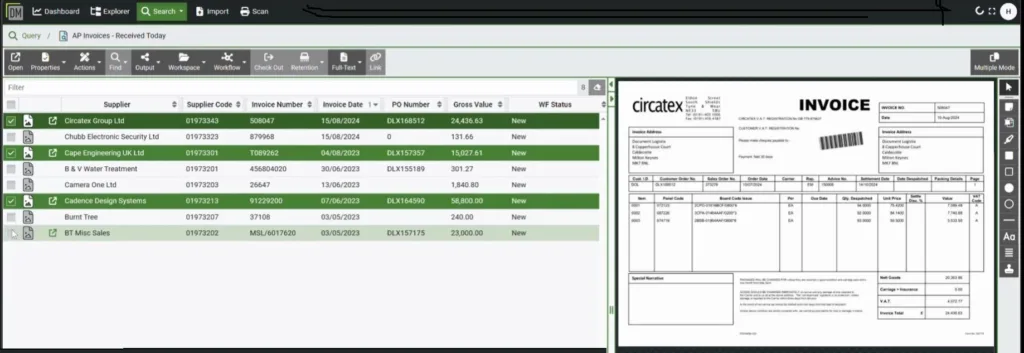
As documents enter your business, either as paper documennts that are OCR scanned, or as electronic documents such as PDFs and emails, they are automatically indexed in Document Manager.
In the case of Document Logistix’ Document Manager, AI-powered data capture and indexing functions maximise filing accuracy, as the system is able to detect metadata such as logos, dates, addresses, car registrations, document fields and free text content. Advanced document ingestion optimises document indexing and filing.
Definition of Document Indexing
Document indexing is the process of organising and categorising documents using metadata, tags, and keywords to enable fast and accurate information searches. This crucial step in modern filing systems allows users to locate specific documents quickly and retrieve relevant information. By implementing document indexing, businesses can streamline their operations, enhance security and ensure compliance with industry standards.
Various tools and techniques, including AI-powered document management systems, metadata tagging software, and manual indexing methods, can be used to achieve effective document indexing.
In today’s business environment, document indexing is essential for efficient and effective management of large volumes of documents. Modern filing systems rely on document indexing to streamline operations, enhance security and ensure compliance with industry standards.
With the increasing amount of paper and electronic documents being generated, document indexing helps organisations manage their information more effectively. Plus, it improves customer satisfaction by providing timely and accurate information, reduces the risk of loss and mismanagement, and enables remote access from multiple locations.
By implementing document indexing, businesses can ensure that their digital filing systems are up-to-date and capable of meeting the demands of modern operations.
Document Management Indexing and Filing Solution
Document management with efficient filing and indexing means that you can handle large volumes of information and provide instant access and reliable answers. Effective document management also emphasises the importance of storing records systematically to ensure they are easily retrievable when needed.
“In a minute” is no longer good enough. When it comes to information, we live in a world that expects “now” and accurate. Do away with manual document filing and indexing and storing digital documents and files in multiple locations.
Store documents and files in a secure central location that provides immediate role-based access to important version-controlled information.
Transform your processes with digital document indexing and filing
Implementing document indexing can bring numerous benefits to an organisation, including:
Improved Efficiency and Productivity
By enabling quick and accurate retrieval of documents, document indexing reduces the time spent searching for information, allowing employees to focus on more important tasks.Enhanced Security and Compliance
Document indexing ensures that documents are stored securely and can be easily retrieved for audits or regulatory reviews, helping organisations to comply with industry standards and legal requirements.Increased Customer Satisfaction
Providing timely and accurate information to customers enhances their experience and builds trust in the organisation.Reduced Risk of Loss and Mismanagement:
Properly indexed documents are less likely to be lost or mismanaged, which reduces the risk of operational disruptions.Remote Access from Multiple Locations
Document indexing enables remote access to documents, allowing employees to work from different locations and improving overall flexibility.Improved Collaboration and Knowledge Sharing
Indexed documents can be easily shared and accessed by team members, which facilitates better collaboration and knowledge sharing.Better Decision-Making with Accurate and Timely Information
With accurate and timely information at their fingertips, decision-makers can make more informed and effective decisions.
Document Manager enables you to turn documents into data and use data cature to improve document processing. Finding the right document indexing solution transforms your processes:
- Eliminates manual data entry and document routing
- Increases data accuracy and provides instant access to data
- Enables you to increase document volume without adding more resources
- Saves you time and supports compliance with automatic indexing
Improve customer satisfaction, reduce defection
If you can’t provide accurate information when a customer wants to know the status of their order or account, there’s a good chance they’ll go somewhere else. To provide accurate information, be it to a customer, co-worker or supplier, there has to be one version of the truth that is immediately accessible.
Even companies that have the majority of their documents in digital format still face issues of access and version control if information is unstructured or stored in too many places. Proper indexing ensures that documents related to customers, suppliers, and other stakeholders are organised and protected, which facilitates quick retrieval and effective decision-making.
There are hundreds of support activities in a business, from ordering raw materials, to manufacturing, dispatching goods, approvals processes, hiring staff, infrastructure management, invoicing and cash collection. Accurate document filing is crucial to keep important activities on track.
Cope with high volumes with efficient indexing and filing
Each step in business is information-heavy with paper and electronic documents. The faster you can capture, file, index and process the information from the mail room, your in-tray or your email inbox, the easier it is to say “now” rather than “I’ll look into it.” With efficient filing and indexing you can give a positive answer rather than a “maybe.”
Electronic document management software harnesses important information so you can store, file, index, retrieve and share information. Knowledge worker staff can perform their roles efficiently, whether they are in a service, production or support position. In turn, you have satisfied customers.
In a non commercial environment, the information could be anything from student applications to property accounts or police records. Document management software makes it straightforward to file, index and manage large amounts of information and eliminate costly delays and disruption.

Digital indexing and filing spin-off benefits
A considered document management framework means that companies can enforce reliable file organisation and optimise their business processes.
There are also valuable spin-off benefits, which include greater security with permission controls, reduced risk of loss, remote access from multiple locations and field operatives, and, with centrally housed documents, the capability to customise a rules-based workflow to ensure consistent performance and maximum output.
Workflow automation for indexed and filed documents
How does workflow automation work for indexed digital documents?
Workflow automation for indexed digital documents involves the use of software systems to streamline, organize, and execute repetitive tasks or processes involving these documents. Here’s a breakdown of how it works:
1. Document Indexing
- Definition
Indexing involves categorising and tagging documents with metadata (e.g., author, date, subject, keywords) to make them easily searchable. - Automation Tools
OCR (Optical Character Recognition) is often used to convert scanned documents into text, while metadata extraction tools tag the documents automatically.
2. Workflow Design
- Definition
A workflow is a sequence of tasks or actions that need to be performed on the documents. - Workflow Design Tools
Business Process Management (BPM) software or Workflow Automation platforms like Document Manager enable users to define workflows visually or programmatically.
3. Triggering Events
- Definition
Workflows start with a triggering event, such as the addition of a new document, an update to a document or a specific date/time. - Examples
A new invoice is uploaded to a shared folder; a contract nearing its expiration date triggers a renewal workflow.
4. Automated Actions
- The system performs predefined actions based on the workflow rules. Common actions include:
- Routing:
Sending the document to specific users or departments for review or approval. - Data Extraction
Pulling specific fields (like invoice amount or due date) from the document for processing. - Notifications
Sending alerts to users when their input or approval is required. - Updates
Modifying metadata, moving the document to a new folder or marking it as “completed.”
- Routing:
5. Integration with Other Systems
- Workflow automation tools such as Document Manager integrate with other enterprise systems, such as:
- CRM Systems
Automatically attach related documents to customer records. - ERP Systems
Sync extracted data (e.g., invoice amounts) with accounting modules. - Email Systems
Trigger automated email reminders or updates.
- CRM Systems
6. Monitoring and Reporting
- The system tracks the progress of workflows and provides dashboards or reports showing:
- Which tasks are pending.
- Who is responsible for the next step.
- Average processing times.
- Benefits
Helps identify bottlenecks and optimise processes.
7. Feedback Loops and Machine Learning
- Advanced systems incorporate machine learning to improve over time, learning from patterns in document processing to:
- Automatically classify new document types.
- Predict common bottlenecks and suggest optimisations.
Examples in use
- Accounts Payable
Automating the processing of invoices, extracting key data and sending them for approval. - HR Onboarding
Automating the collection, storage and review of employee documents like contracts and ID verification. - Legal Workflows
Managing contract approvals, ensuring compliance and tracking document versions.
Automation benefits
- Efficiency
Reduces manual effort and processing times. - Accuracy
Minimises human errors in document handling. - Compliance
Ensures processes follow regulatory requirements by standardising actions, such as data retention and purge in line with GDPR guidelines. - Scalability
Easily manages increased document volumes without additional manual effort.
Digital document indexing and filing enhances compliance
Digital document filing and indexing enhances compliance by ensuring documents are stored securely, encrypted, accurately categorised and easily retrievable for audits or regulatory reviews. Methods like flat file, where documents are organised in a flat position within folders, can also be digitised to ensure secure and efficient document management. Automated metadata tagging, access controls and version tracking prevent unauthorised changes and data loss.
Document Manager streamlines adherence to legal standards, reduces errors and facilitates timely reporting tp protecting organisations from penalties and legal risks.
Q&A about document indexing and filing
1. What is document filing, and why is it important?
- Answer: Document filing involves organising and storing documents systematically to ensure they are easy to retrieve and manage. It is important because it improves efficiency, ensures compliance with regulations, protects sensitive information and reduces the time spent searching for documents.
2. How does indexing improve document filing systems?
- Answer: Indexing involves tagging documents with metadata (e.g., titles, keywords, dates) to make them searchable. It enhances the filing system by enabling quick retrieval, supporting categorisation and reducing redundancy, especially in large archives.
3. What tools are commonly used for document indexing?
- Answer: Tools like OCR software for text recognition, and Document Management Systems (DMS) such as Document Manager are commonly used. Tools automate metadata tagging, search functionality and workflow integration.
4. What are best practices for effective digital document filing and indexing?
- Answer:
- Use a consistent naming convention.
- Apply clear and comprehensive metadata.
- Categorise documents based on function, type or department.
- Leverage automated tools for indexing and filing.
- Regularly audit the document repository.
Ready to learn more about digital document indexing and filing?
Ready to learn more about digital indexing and filing? Ask a question about how you could enhance your current filing set-up.
Case Study: Enhancing Document Indexing and Filing with AI
A legal firm managing thousands of client files faced challenges with manual document indexing and filing, which led to delays and mismanagement. Implementing an AI-powered document management system transformed their operations.
The AI system automatically categorised documents based on content and extracted key metadata to ensure accurate filing. The indexing and filing system integrated optical character recognition (OCR) for digitising paper records and enabled quick retrieval through advanced search features.
As a result, the firm reduced indexing time by 75%, improved file accuracy and ensured compliance with record-keeping standards to boost overall efficiency.