
The Benefits of Creating a Document Retention Policy
Every organisation relies on information. Whether it’s a signed contract, an employee’s personnel file, a VAT invoice or an email confirming a customer’s order, documents are the evidence of how a business operates. They support day-to-day decisions, demonstrate compliance with the law and provide a record of important events. Yet despite their value, many businesses give surprisingly little thought to how long those documents should be kept or what should happen to them when they are no longer needed.
It’s easy to see how the problem develops. Storage is cheaper than it once was, cloud services offer virtually unlimited capacity and deleting information can feel risky. The result is that many organisations adopt an unofficial policy of keeping everything. While that might seem like the safest option, it often creates more problems than it solves. Unnecessary records increase storage costs, make information harder to find, expose businesses to greater cybersecurity risks and may even breach data protection legislation.
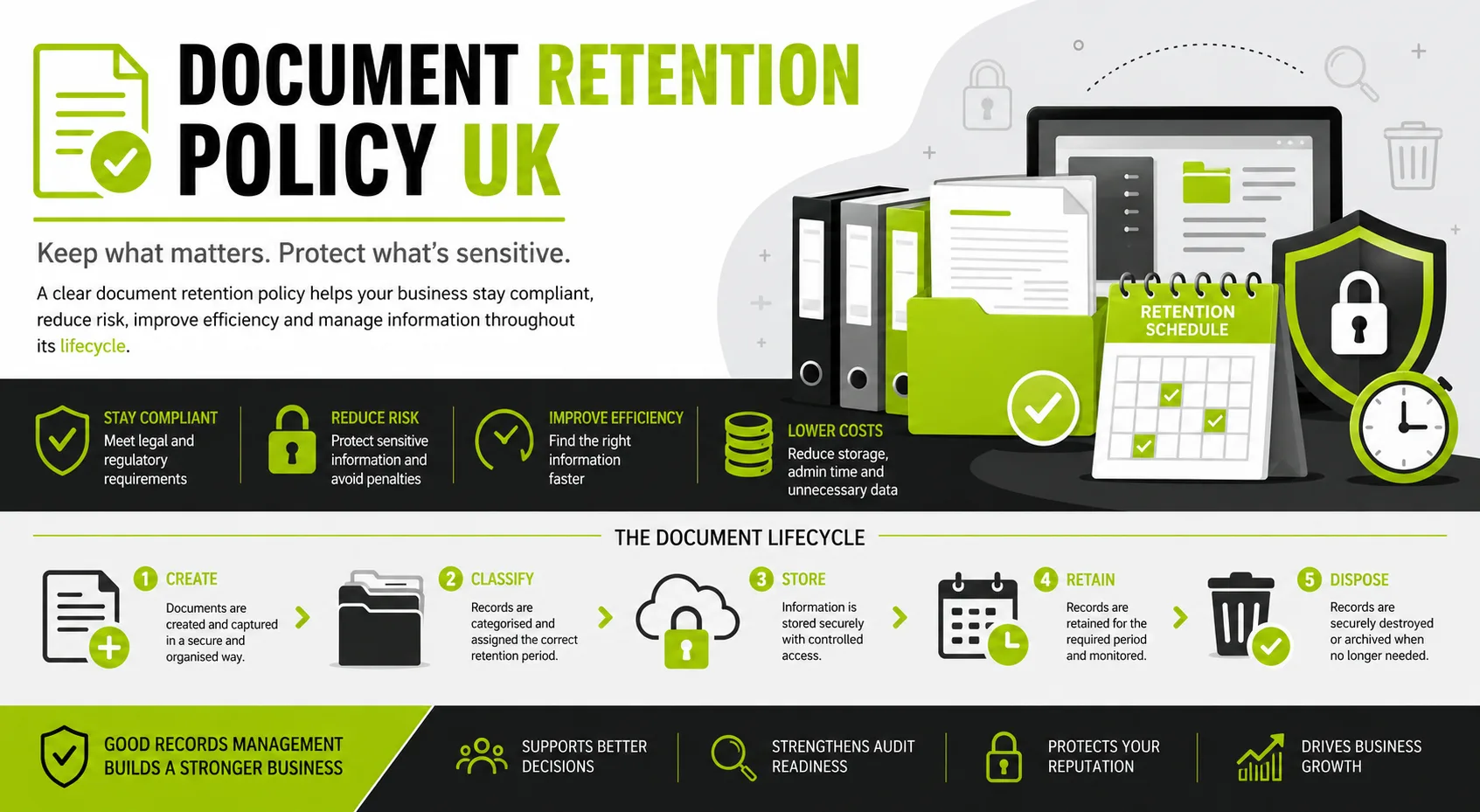
A well-written document retention policy provides clarity. It establishes how information should be managed throughout its lifecycle, from the moment it is created or captured to the point at which it is securely destroyed. More importantly, a retention policy helps organisations to meet their legal obligations while ensuring that valuable information remains accessible when it is genuinely needed.
For UK businesses, document retention isn’t governed by a single piece of legislation. Instead, it is covered by several legal and regulatory requirements, including UK GDPR, HMRC record-keeping rules, the Companies Act 2006 and employment legislation. Understanding how these requirements fit together can seem daunting, but the underlying principle is straightforward: keep records for as long as there is a legitimate reason to do so, and no longer.
This guide explains what a document retention policy is, why every organisation should have one, how long common business records should be kept, the challenges businesses typically face and the practical steps that can help to build a compliant and efficient records management programme.
What is a document retention policy?
A document retention policy is a formal framework that sets out how an organisation manages its records throughout their lifecycle. A retention policy defines what information should be retained, where it should be stored, who is responsible for managing it, how long it should be kept and the process for securely disposing of it when it reaches the end of its retention period.
Although people often think of filing cabinets full of paperwork when they hear the word “document”, today’s businesses hold information in countless formats. Contracts may be stored in a document management system, invoices in accounting software, emails in Microsoft 365, customer records in a CRM platform and project files in cloud storage. Instant messaging platforms, scanned documents and electronic forms all contribute to the growing volume of business information.
An effective retention policy brings all these records together under one consistent approach. Instead of relying on individual departments to decide what to keep, the organisation establishes clear rules for everyone to follow. This not only improves consistency but also reduces the likelihood of important records being deleted too early or retained indefinitely.
It’s also worth distinguishing between documents and records. Not every document is an official business record. Draft versions of a report, duplicate copies of files or temporary working notes may have little long-term value. A signed contract, an approved invoice or a completed personnel record, however, forms part of the organisation’s official record and should be managed accordingly. Understanding the distinction between documents and records helps to reduce unnecessary storage and ensures that genuinely important information is preserved.
Why document retention matters
Document retention is sometimes viewed as little more than an administrative task, but its impact extends far beyond filing and storage. Effective records management supports compliance, protects sensitive information and helps organisations to work more efficiently.
Consider a business responding to an HMRC enquiry. If financial records are incomplete or difficult to locate, the investigation is likely to become more time-consuming and stressful. Equally, if an employee brings an employment tribunal claim, accurate personnel records may prove crucial in demonstrating that the organisation acted fairly and lawfully.
There is also the issue of data protection. UK GDPR requires organisations to follow the storage limitation principle, meaning personal data should not be kept for longer than necessary. Holding large quantities of outdated personal information doesn’t simply consume storage space; it increases the amount of data that could potentially be exposed if a cyber-attack or data breach occurs.
Operational efficiency is another important consideration. Most employees have experienced the frustration of searching multiple folders, inboxes or shared drives for a document that should have been easy to find. As organisations generate thousands of new files every month, poor records management gradually erodes productivity. A structured retention policy, supported by consistent classification and indexing, makes information easier to locate and reduces the time spent searching for it.
In short, document retention is about much more than deciding what to throw away. It’s about ensuring that the right information is available at the right time while reducing unnecessary risk.
Understanding the UK’s legal framework
One of the biggest misconceptions surrounding document retention is that there must be a single law stating exactly how long every document should be kept. In reality, the position is far more nuanced. Different types of records are subject to different legal requirements, and in some cases, there is no prescribed retention period at all.
The legislation that has perhaps the greatest influence on document retention today is UK GDPR. One of its core principles is known as storage limitation, which requires organisations to retain personal data only for as long as it is needed for the purpose for which it was collected. This means businesses should be able to explain why they are holding personal information, how long they intend to keep it and when it will be securely deleted. Keeping personal data indefinitely “just in case” is unlikely to satisfy this requirement.
Alongside UK GDPR sits the Companies Act 2006, which requires companies to maintain accounting records and statutory registers for specified periods. These records provide evidence of a company’s financial position and support transparency in corporate governance.
HMRC also imposes record-keeping obligations on businesses. Documents relating to VAT, Corporation Tax, payroll and other financial matters must generally be retained for several years to support tax reporting and compliance. If records cannot be produced during an inspection or enquiry, businesses may face penalties or find it difficult to defend their tax position.
Employment legislation adds another layer of responsibility. Employers routinely process large volumes of personal information, from recruitment records and right-to-work checks to payroll information and pension documentation. Some of these records must be retained to meet statutory obligations, while others are kept because they may be needed if legal claims arise after employment has ended.
Taken together, these legal requirements demonstrate why a one-size-fits-all approach simply doesn’t work. Different categories of information have different purposes, different risks and different retention periods. An effective document retention policy recognises these differences and provides clear guidance for every type of business record.
Recommended document retention periods in the UK
One of the questions businesses ask most often is, “How long should we keep our documents?” Unfortunately, there isn’t a single answer. Retention periods depend on the type of record, the legislation that applies and, in some cases, the specific circumstances of the organisation.
That said, there are well-established guidelines that most UK businesses follow. These guidelines provide a sensible starting point when developing a document retention schedule.
Financial records, including invoices, bank statements, VAT records and supporting accounting documents, are typically retained for at least six years. This retention period reflects HMRC’s record-keeping requirements and enables businesses to support tax returns and respond to enquiries if necessary.
Employment records require a more considered approach because they often contain sensitive personal information. Payroll records, pension information, contracts of employment and disciplinary records may all have different retention periods depending on their purpose. Many organisations choose to retain employee records for several years after employment ends to help defend against potential legal claims, while ensuring that hey are not kept indefinitely without justification.
Contracts are another important category. Even after an agreement has expired, businesses often retain copies for several years in case disputes arise over obligations, warranties or payments. Property records, intellectual property documentation and certain health and safety records may need to be retained for considerably longer, particularly where legal liabilities can extend over many years.
Rather than relying on assumptions, organisations should develop a document retention schedule that lists every major category of record alongside its retention period, legal basis and disposal method. Creating a schedule provides consistency across the business and removes uncertainty for employees responsible for managing information.
The retention schedule should not be viewed as a static document. Laws change, industries evolve and businesses introduce new systems and processes. Reviewing the schedule annually helps to ensure that it remains accurate and continues to reflect current legal and operational requirements.
More than paperwork: managing digital records
When people think about document retention, they often picture filing cabinets and archive boxes. In reality, most business information now exists in digital form, and this presents an entirely different set of challenges.
Emails are perhaps the most obvious example. A single employee can generate thousands of emails each year, many of which contain contracts, customer information or commercially sensitive discussions. Without clear rules, inboxes quickly become long-term storage systems rather than communication tools.
Cloud storage creates similar issues. Services such as Microsoft 365, Google Workspace and SharePoint have transformed collaboration, which makes it easier than ever for employees to create and share documents. However, convenience often comes at the cost of duplication. The same file may exist in several folders, with multiple versions saved by different people. Over time, it becomes increasingly difficult to identify which document is current and which can safely be deleted.
There is also the challenge of collaboration platforms. Instant messaging applications, shared workspaces and project management tools frequently contain decisions that would once have been documented in formal correspondence. If these records form part of the organisation’s official business activities, they should be considered within the document retention policy rather than overlooked simply because they sit outside a traditional filing system.
Digital transformation has undoubtedly improved productivity, but it has also made records management more complex. Businesses now need policies that cover information wherever it is stored, not just the documents held in a central archive.
Common information management challenges businesses face
Even organisations that understand the importance of document retention often struggle to put an effective policy into practice. The challenges are rarely caused by a lack of good intentions. More often, they arise because information has accumulated gradually over many years, spread across different systems and managed by different departments.
One of the biggest issues is volume. Every day, businesses create proposals, contracts, invoices, meeting notes, emails, spreadsheets and reports. Individually, each document may seem insignificant, but collectively they represent a growing archive that soon becomes difficult to manage. Without a structured approach, employees tend to save everything because deciding what can safely be deleted takes time and confidence.
Another common problem is inconsistency. One department may archive documents after three years, while another keeps similar records indefinitely. Some employees store files on shared drives, others save them in cloud platforms, and a few continue to rely on local folders on their laptops. The result is a fragmented information landscape where nobody is entirely certain which version of a document is the definitive one.
Staff turnover creates further complications. Employees leave and take valuable knowledge with them. New starters inherit folders full of unfamiliar documents but have little understanding of which records are still relevant. Rather than risk deleting something important, they simply leave everything untouched. Over time, lack of admin housekeeping creates digital clutter that continues to grow year after year.
Legacy systems can also present significant obstacles. Many organisations still maintain older databases or document repositories because they contain historical records that might one day be needed. Migrating or reviewing these systems requires time and resources, so they often remain in place long after their original purpose has disappeared.
Then there is the challenge of remote and hybrid working. Information is no longer created exclusively within the office. Employees access documents from home, collaborate through cloud platforms and communicate using messaging applications on multiple devices. While this flexibility brings many benefits, it also increases the risk of inconsistent document management if policies have not kept pace with changing ways of working.
The hidden risks of keeping everything
At first glance, retaining every document might seem like the cautious approach. Storage is relatively inexpensive, and deleting information can feel irreversible. Many organisations therefore adopt an informal policy of saving everything “just in case”.
Ironically, retaining all information can create greater risk than disposing of records appropriately.
From a compliance perspective, retaining personal information longer than necessary may conflict with the storage limitation principle under UK GDPR. If an organisation cannot justify why it still holds personal data years after its original purpose has ended, it may struggle to demonstrate compliance.
Cybersecurity is another concern. Every additional document containing personal, financial or commercially sensitive information represents another asset that must be protected. If a cyber-attack occurs, organisations holding decades of unnecessary information potentially expose far more data than would otherwise be the case.
There are operational consequences too. Anyone who has searched through multiple versions of the same spreadsheet or spent half an hour looking for a signed contract understands how excessive document retention affects productivity. Employees waste valuable time searching, verifying and comparing files instead of focusing on meaningful work.
Large volumes of redundant information also increase the cost of legal disclosure exercises. During litigation or regulatory investigations, businesses may be required to search vast quantities of historical records. The more unnecessary information that has been retained, the more expensive and time-consuming these search exercises become.
In other words, keeping everything is rarely the safest option. Effective document retention is about balance: preserving information that has genuine legal, operational or historical value while disposing of records that have reached the end of their useful life.
A practical retention example
Imagine two medium-sized businesses operating in the same sector.
The first has never developed a document retention policy. Over the years, employees have stored files wherever they found convenient: local hard drives, email inboxes, cloud folders and shared network drives. There are multiple copies of contracts, duplicate invoices and outdated customer records dating back more than a decade. When an auditor requests financial documentation, staff spend days trying to locate the correct versions. At the same time, the organisation continues to store personal information belonging to former employees and customers without any clear justification.
The second business takes a different approach. It has implemented a document retention schedule that covers every major category of information. Documents are classified consistently, retention periods are clearly defined and obsolete records are securely disposed of according to policy. When auditors request evidence, staff can locate it within seconds. Personal data that is no longer required has already been removed, which reduces both compliance risk and storage costs.
The difference between the two organisations is not simply better filing. It is better governance. A structured approach to document retention enables the second business to work more efficiently, respond more confidently to regulatory requests and demonstrate that it takes information management seriously.
This illustrates an important point: an effective document retention policy is not about creating more bureaucracy. Done well, a retention policy reduces complexity by ensuring that everyone understands what should be kept, what can be deleted and why those decisions matter.
How to create a document retention policy
Once an organisation recognises the need for a document retention policy, the next question is usually where to begin. Fortunately, creating an effective policy is less about writing a lengthy document and more about understanding the information your business holds and establishing practical, consistent rules for managing it.
The first step is to carry out an information audit. Before deciding how long records should be retained, you need to know what exists. This exercise often reveals that documents are stored in far more places than anyone realised. Alongside filing cabinets and network drives, records may be scattered across cloud storage platforms, email systems, accounting software, HR applications, customer relationship management (CRM) systems and employees’ laptops.
Once you have identified where information is stored, the next stage is to classify it. Most organisations find it helpful to group records into broad categories such as finance, human resources, legal, customer information, operational records and marketing. These categories can then be broken down into more specific document types, each with its own retention period.
The policy should also identify the legal or business reason for retaining each category of information. This creates a clear audit trail and demonstrates that retention periods have been chosen carefully rather than arbitrarily. If a regulator, auditor or customer asks why certain records are still being held, the organisation can provide a documented explanation.
Responsibilities should also be clearly defined. Records management is rarely the sole responsibility of one department. Finance teams manage accounting records, HR oversees personnel files, legal teams retain contracts and IT often maintains the systems where information is stored. A successful policy makes it clear who is responsible for managing each category of record while ensuring that there is overall governance across the organisation.
Finally, the policy should explain what happens when records reach the end of their retention period. Some information may be archived because it has historical value, while other documents should be securely destroyed. Whatever the approach, the process should be documented, consistent and capable of being audited.
Why automation is becoming essential
A decade ago, many businesses managed document retention using spreadsheets and calendar reminders. Someone would periodically review folders, identify documents that had reached the end of their retention period and arrange for them to be archived or deleted.
That approach may still work for a small organisation with relatively few records, but it becomes increasingly difficult as businesses grow. Thousands of new documents can be created every week, making manual management both time-consuming and prone to error.
This is where modern document management software has transformed records management.
Rather than relying on individuals to remember retention dates, intelligent systems can automatically classify documents, apply retention rules and trigger actions when records reach the end of their lifecycle. They can also notify authorised users before deletion takes place, to ensure that important records are not removed accidentally.
Many organisations are also beginning to use artificial intelligence to assist with document management. AI can identify document types, extract key information, recognise duplicate files and suggest appropriate classifications. While human oversight remains essential, these technologies significantly reduce the administrative burden associated with managing large volumes of information.
Automation also creates consistency. Every document is managed according to the same rules, regardless of which department created it or where it is stored. Automation reduces the likelihood of errors and provides confidence that retention policies are being applied consistently across the organisation.
The importance of audit trails
One feature that is often overlooked, but can prove invaluable, is the audit trail.
An audit trail provides a complete history of a document throughout its lifecycle. An audit trail records who created the document, who viewed it, who amended it, when changes were made and when the document was archived or deleted.
This level of transparency offers significant advantages.
If a regulator asks when a record was deleted, the organisation can provide evidence rather than relying on assumptions. If a dispute arises over which version of a contract is the final version, version history provides a clear answer. During internal investigations or external audits, audit trails demonstrate that records have been managed consistently and in accordance with documented policies.
In many respects, the audit trail is just as important as the document itself because it provides evidence that information has been handled responsibly throughout its lifecycle.
Secure disposal: the final stage of the document lifecycle
Disposal is often treated as an afterthought, yet it is one of the most important stages of records management.
Simply dragging a file into a recycle bin or placing paper documents in a standard waste bin is unlikely to provide adequate protection for confidential information.
Digital records should be deleted permanently using methods that prevent unauthorised recovery, while paper documents containing sensitive information should be shredded or disposed of through an approved confidential waste service.
Organisations should also maintain records of disposal activities. Recording what was destroyed, when it was destroyed and under whose authority provides valuable evidence should questions arise later.
Secure disposal not only reduces storage costs but also limits the amount of sensitive information that could potentially be exposed during a security incident.
Common records management mistakes businesses make
Despite good intentions, many organisations continue to make avoidable mistakes when managing their records.
Perhaps the most common is failing to have a documented policy at all. Employees are left to make their own decisions about what should be kept, which leads to inconsistency across departments.
Another frequent mistake is applying the same retention period to every document. Different records serve different purposes, and a single retention period rarely satisfies every legal or operational requirement.
Many businesses also overlook email. Important commercial decisions, contractual agreements and customer instructions are often communicated electronically, yet email retention is frequently excluded from formal policies.
Cloud storage can create similar problems. Because storage appears almost limitless, businesses may continue accumulating outdated documents without ever reviewing them. Over time, this creates unnecessary costs and makes locating important information increasingly difficult.
Training is another area that is often neglected. Even the best-written policy will have little value if employees are unaware of it or do not understand how it should be applied. Records management should form part of staff induction and be reinforced through regular refresher training.
Finally, some organisations mistakenly assume that system backups replace proper document retention. Backups are designed to restore systems after technical failures or cyber incidents. They are not intended to act as long-term archives or satisfy legal retention requirements.
Best practice for effective records management
The organisations that manage information most effectively tend to share several characteristics.
They review their document retention policy regularly rather than allowing it to gather dust. As legislation changes and the business evolves, retention schedules are updated to reflect new requirements.
They invest in employee awareness and recognise that records management is everyone’s responsibility rather than solely the concern of IT or compliance teams.
They restrict access to sensitive information according to job roles to reduce the likelihood of unauthorised access while ensuring that employees can still find the records they genuinely need.
They also embrace automation wherever practical. Rather than depending on manual processes, they use technology to classify documents, enforce retention rules and maintain audit trails automatically.
Perhaps most importantly, they recognise that document retention is not simply about compliance. It is about creating an organised, efficient and resilient organisation where information can be trusted, located quickly and managed confidently.
Results businesses can expect
When a document retention policy is implemented successfully, the benefits become apparent surprisingly quickly.
Employees spend less time searching for documents because information is organised consistently and duplicate records are reduced. This improves productivity across the organisation and enables teams to focus on higher-value work.
Compliance also becomes easier to demonstrate. Instead of scrambling to locate evidence during audits or regulatory inspections, organisations can produce records promptly, supported by clear audit trails and documented retention schedules.
Information security is strengthened because unnecessary personal and confidential data is no longer retained indefinitely. By reducing the amount of sensitive information held, organisations also reduce the potential impact of a cyber-attack or data breach.
Financial savings should not be overlooked either. Lower storage requirements, reduced administrative effort and shorter audit preparation times all contribute to measurable cost reductions.
Perhaps the greatest benefit, however, is confidence. Decision-makers know that information is being managed consistently, employees understand their responsibilities and the organisation is better prepared to respond to legal, regulatory and operational challenges.
Retention Policies: Conclusion
A document retention policy is far more than a compliance document. It is a practical framework that helps organisations to manage one of their most valuable assets: information.
As businesses continue to embrace digital transformation, the volume of records they generate will only increase. Without clear rules governing how information is stored, retained and disposed of, organisations risk creating unnecessary costs, operational inefficiencies and compliance issues.
By understanding legal obligations, developing a comprehensive document retention schedule and supporting it with effective records management practices, businesses can improve productivity while reducing risk. Modern document management software and automation make this process easier than ever, and enable organisations to manage growing volumes of information without increasing administrative burdens.
Ultimately, an effective document retention policy is about balance. It ensures that important records remain available when needed, while information that no longer serves a legitimate purpose is securely removed. In doing so, organisations not only meet their legal obligations but also build stronger governance, improve operational efficiency and create a more secure foundation for future growth.
Frequently Asked Questions
What is a document retention policy?
A document retention policy is a formal document that explains how long different categories of business records should be kept, where they should be stored and when they should be securely destroyed.
What is a document retention schedule?
A document retention schedule is a detailed list of document types together with their recommended retention periods, legal basis for retention and disposal method.
How long should businesses keep invoices in the UK?
In most cases, businesses retain invoices for at least six years to meet HMRC and accounting requirements, although some circumstances may require longer retention.
Does UK GDPR specify exact retention periods?
No. UK GDPR does not prescribe fixed retention periods. Instead, organisations must keep personal data only for as long as it is necessary for the purpose for which it was collected.
Are emails covered by a document retention policy?
Yes. Business emails often contain contracts, financial information and personal data, which makes them important business records that should be managed under the organisation’s retention policy.
Who is responsible for document retention?
Responsibility is usually shared across the organisation. Individual departments manage their own records, while overall governance often sits with senior management, compliance teams or information governance specialists.
How often should a document retention policy be reviewed?
Most organisations review their policy at least once a year, or sooner if legislation, business processes or regulatory requirements change.
Can document retention be automated?
Yes. Modern document management systems can automatically classify records, apply retention schedules, maintain audit trails and securely dispose of documents once their retention period expires.
What happens if records are deleted too early?
Deleting records prematurely can make it difficult to demonstrate legal compliance, defend claims or respond to audits and regulatory investigations. It may also result in the permanent loss of valuable business information.
What is the difference between archiving and deleting?
Archiving moves records into secure long-term storage where they remain accessible if needed. Deleting permanently removes information once there is no longer a legal or business reason to retain it.
Do small businesses need a document retention policy?
Yes. Organisations of every size create records that are subject to legal and regulatory requirements. A clear policy helps small businesses remain organised, compliant and prepared for future growth.
Why is secure disposal important?
Secure disposal ensures that confidential information cannot be recovered after deletion. It reduces compliance risks, protects sensitive data and demonstrates responsible information governance.