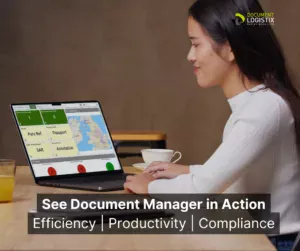
With MHR integration customers can manage their HR documents through a single point of control
MHR’s partnership with Document Logistix means that our HR iTrent customers can place all document types – paper, digital files, audio and video assets – into a centrally controlled system that manages complex information by type.
At-a-touch organisation of documents and data becomes routinely embedded in your organisation’s daily processes. Find out more about MHR integration.
The many benefits of integrating your HR solution with a full document management system
While digital document management has its origins in the Accounts department, it has migrated across most departments and HR is adopting digitisation for many compelling business-critical reasons.
Access control, a single point of storage and communication, GDPR compliance and automated retention/deletion all provide significant benefits in terms of workflow efficiency and security.
Document Logistix award-winning software, Document Manager (Product of the Year), can be fully integrated with MHR solutions. Document Manager enables organisations to store documents and data in a secure, cross-departmental central hub, which avoids risks of duplication.
The system also enables administrators to manage and closely control data access levels. HR departments store sensitive information, so each system user can be restricted to access only the information they need to perform their job.
Integration: The power of instant search in iTrent
Some of our customers have millions of records in their systems, so the prospect of manual search is simply impracticable. Competing systems’ ‘clunky’ search techniques frequently show duplicate or multiple versions of the same document.
Users of MHR products integrated with Document Manager experience the most powerful search capabilities, with simple to use filters that clearly identify documents by a wide range of search parameters.

Meeting privacy requirements
Organisations are obliged to govern access to internally-held sensitive information, while recent legislation imposes strict rules on how personal data is shared that has highlighted the requirement for masking (redaction) solutions.
An easy way to imagine redaction in the historical world of paper is to picture a familiar scene in spy films, when words in documents are blanked and labelled “Top Secret.” An analogue form of redaction!

In a digital age, many documents are stored on in-house servers or in the Cloud, where people have direct access from anywhere in the world.
The documents stored cover a vast range of types and topics, from company accounts and HR records to proprietary assets and criminal case matter. There are many instances when an individual will need access to some of the information contained in a document, but some aspects of the document are too sensitive for unapproved people to see.
Masking sensitive in-house information
Consider the case of the payment details or the pension details of a senior executive that are held among a company’s HR records.
While the HR Director may need to have access to complete information, it would be a risk to allow all members of the HR team to have the same access. The risk could be reputational or legal, or both. For example, if information were leaked by a dissatisfied, or merely careless employee, the resulting publicity could be damaging if it became a ‘fat cat’ story in the media. There could also be severe financial implications in the event of a data privacy breach.
To protect sensitive information in digital documents (whether scanned or electronic in origin), appropriate access rights can be assigned so that if a staff member does not have rights, information will be completely ‘blacked out’. For example, while the executive’s payment schedule or transaction dates may be readable, the financial details could be redacted.
Access rights can be granted progressively and automated so that system users see more or less of a document, depending on what they need to see to carry out their job.
A unified system provides census audit trails
Security is a significant factor in best-practice HR operations. Systems integration means that there is a full record of each time a user accesses the system and a time-stamped log of activity.
A rules-based system requires minimal IT or management intervention and facilitates employee self-service, which greatly reduces the amount of time spent by key staff on low-level admin tasks.
Simplifying the compliance life-cycle
The introduction of GDPR in 2018 placed an even greater duty of care on HR professionals in terms of the data they keep and how it is stored. MHR HR document management integration helps organisations to manage and automate data privacy from the time information is captured, through any mandatory retention periods, to the time data is destroyed.
Document indexing on upload, automated system alerts and assured timely data deletion help our customers to embed effective compliance practice in their daily operations. Complete histories of large amounts of complex data can be produced in seconds to satisfy strict audit standards.
Managing mandatory retention and destruction
HR documents have specified lifespans that vary across standard employee records, disciplinary records, visas and ‘right to work’ documents, pensions, and many different types of information.
Paper systems, manual data management, hybrid and non-automated systems create a multitude of problems, from simple logistical issues associated with mass storage, access and staff time, to human error and even the potential for negligence or malpractice.
Digital document management makes it simple for organisation to identify and store documents by type so that they can be retrieved, reviewed, retained or destroyed according to company policy and industry regulations.