
Introduction: Why Planning Matters More Than Ever
Take advantage of our Digital Readiness Review.
In April 2026 organisations are navigating a messy and unpredictable business landscape. The end of the financial year brings familiar pressures: budget reviews, tax adjustments and compliance deadlines. But this year they are more intense.
Minimum wage changes and shifting tax structures are reshaping cost bases, while global instability – from the Ukraine conflict to Middle East tensions – is disrupting supply chains and driving up energy costs.
In some regions, remote work is back and even petrol rationing has been introduced. Meanwhile the news cycle is relentless and decision makers can easily delay big investments.
And that’s the problem.
Don’t Postpone the Benefits of Digitisation
When organisations put off big technology decisions – especially those involving process change – they also put off the very efficiencies that will help them weather uncertainty. Digital document management is one of those investments.
It may feel like a ‘big ticket’ item but the reality is that much of the success depends not on immediate spend but on careful planning.
This is where Document Logistix comes in. With over thirty years’ experience and multiple industry awards – Company of the Year, Business Process Automation, Records Management and Document Management Product of the Year – our approach is not about pushing for quick buys
We focus on guiding organisations through a staged journey to digital transformation. This is the perfect time to find out about our Digital Readiness Review.
The Case for Planning Now (Even If You’re Not Buying Yet)
It’s understandable that organisations hesitate to commit to new systems during uncertain times. But delaying altogether can be costly in ways that are not so obvious.
Every quarter without digital document management means:
- Continued inefficiencies in document retrieval
- Increased risk of compliance breaches
- Lost productivity across departments
- Reduced employee morale owing to repetitive manual tasks
Planning is low risk and high value. Planning enables organisations to:
- Build a business case
- Identify quick wins and ROI
- Prepare teams for change
- Reduce implementation risks down the line
Think of it this way: while others delay, you can prepare. And when things the conditions are right, you will be ready to act.
Building a Business Case for Document Management
Before you implement any system, you need to understand and articulate the value.
A business case for a document management system (DMS) should cover three key areas:
1. Cost Savings
How much time do employees spend searching for documents? Industry estimates suggest several hours per week per employee. Multiply that across your organisation and the cost is massive.
Digitisation reduces:
- Printing and storage costs
- Physical archiving expenses
- Administrative overhead
2. Productivity Gains
A well implemented DMS enables:
- Instant document retrieval
- Automated workflows
- Faster approvals and decision making
Process improvements translate into measurable productivity gains across departments such as Accounts, HR and Sales.
3. Risk Reduction
Compliance requirements are tightening. A DMS helps mitigate risks by:
- Enforcing access controls
- Maintaining audit trails
- Supporting regulatory compliance, such as retention automation to comply with GDPR
When these outcomes are quantified, the ROI is clear … before you even start.
Risk Assessment and DPIA: A Critical Foundation
One of the most overlooked – but essential – steps in planning a document management system is conducting a Data Protection Impact Assessment (DPIA).
DPIAs are not optional. They are a regulatory requirement for systems that process personal data. Yet many organisations struggle with them.
In some sectors, such as healthcare, there is a tendency to reuse or adapt existing DPIAs. While this may save time it can expose organisations to scrutiny if the assessment does not accurately reflect their specific processes.
Working with Document Logistix’ experts ensures your DPIA is:
- Thorough and tailored
- Compliant with current regulations
- Matched to your everyday data flows
Using a structured template can simplify the DPIA process but expertise is key to getting it right.
Identifying High Impact Processes for Quick ROI
Not all processes deliver equal value when digitised. A critical part of planning is identifying where a DMS can make the biggest immediate impact.
Common high value areas include:
Accounts Payable
- Invoice processing automation
- Faster approvals
- Reduced late payment penalties
- Security and audit trails
Human Resources
- Secure employee record management
- Streamlined onboarding
- Compliance with data protection laws
Sales and Customer Management
- Centralised customer documentation
Quick Wins
By identifying and focusing on areas that will benefit most, enables organisations to show quick wins and build momentum for wider document management adoption.
What Does Staged Implementation Look Like?
A full implementation can feel overwhelming, which is why a staged approach is often the best way.
What a 5-to-9 month roadmap might look like:
Phase 1: Discovery and Planning
- Define objectives and KPIs
- Conduct risk assessments and DPIA
- Identify priority processes
Phase 2: System Design
- Define security protocols (principle of least privilege)
- Plan integration with your current systems (Accounts, HR, ERP, CRM)
- Develop a migration strategy
Phase 3: Pilot Implementation
- Roll out to one department
- Test workflows and automation
- Gather feedback
Phase 4: Organisation-Wide Rollout
- Roll out to additional departments
- Provide training and support
- Monitor performance against KPIs
Phase 5: Optimisation
- Refine workflows
- Introduce additional automation
- Scale capabilities
A staged approach to document management implementation reduces risk and ensures that each step is effective for your organisation.
The Essential Core: Centralised Data
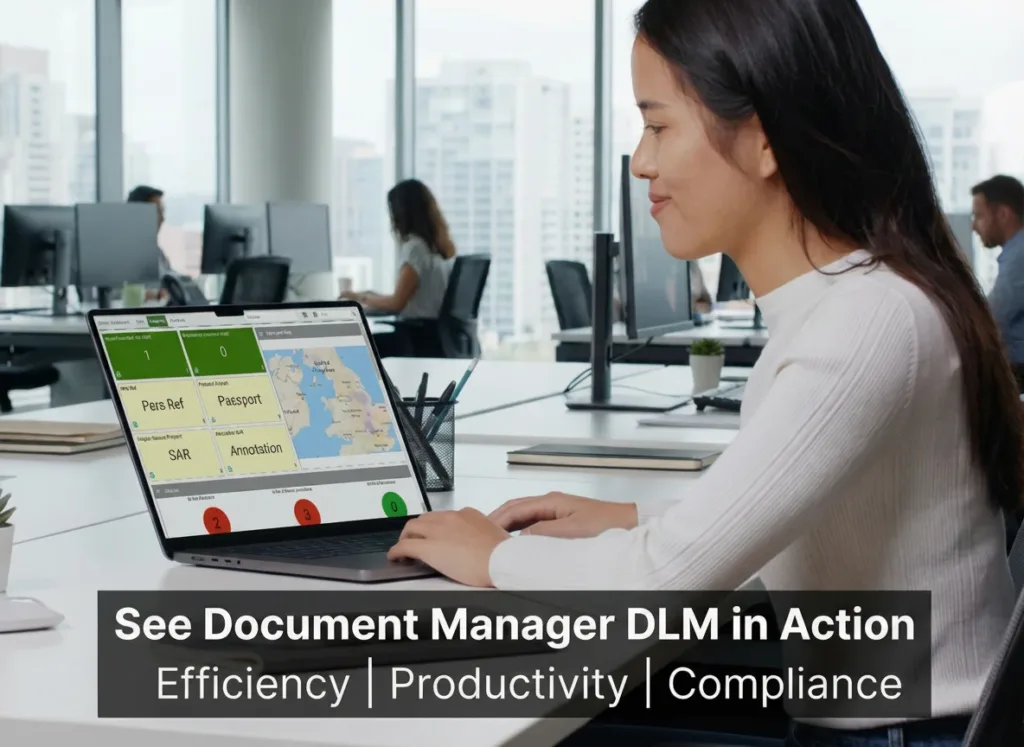
One of the biggest benefits of a document management system is centralisation.
Instead of documents being scattered across:
- Email inboxes
- Shared drives
- Personal folders
- Paper archives
A DMS creates a single source of truth.
Centralisation means:
- Improved data security
- Improved collaboration
- Eliminated duplication
- Greater visibility across the organisation
For all businesses, access to accurate, real-time information is key.
Integration: Making Your Systems Work Together
A document management system shouldn’t exist in isolation.
Modern organisations use multiple systems including:
- HR platforms
- ERP systems
- CRM tools
Integration means documents flow seamlessly between these systems, which means:
- Automated data capture
- Consistent record-keeping
- Reduced manual input
Document Logistix ensures its Document Manager solution integrates with your current infrastructure to minimise disruption and maximise benefit.
Security and Compliance: More Than Just a Box to Tick
Security is often the top concern when considering digital transformation, and rightly so.
A robust DMS should have:
- Encryption (in transit and at rest)
- Role-based access controls
- Audit trails
Regular Testing
Compliance is just as important, especially with changing regulations.
Planning enables you to:
- Define security protocols early
- Meet compliance requirements
- Avoid costly retro-fitting later
Cloud vs On-Premises: What’s Right for You?
Another decision is deployment.
Cloud-Based
- Lower upfront costs
- Scalability
- Remote access
On-Premises
- More control
- Customisation
- Data residency benefits
The right choice depends on your organisation’s needs, risk profile and infrastructure. Our expert guidance will help you to make an informed decision.
Why Not Just Use Dropbox or SharePoint?
It’s a common question: why invest in a dedicated document management system when tools like file-sharing platforms already exist?
The answer is functionality.
While general-purpose platforms offer storage and sharing, a dedicated DMS provides:
- Advanced workflow automation
- Compliance features
- Structured document control
- Integration capabilities
- Audit and reporting tools
In short, systems like Document Manager are designed to manage documents as part of business processes, not just store them.
Managing Change: The Human Factor
Technology alone won’t guarantee success.
One of the most critical aspects of implementation is managing cultural change.
Employees may resist new systems because of:
- Attachment to existing processes
- Fear of complexity
- Job impact concerns
Good change management includes:
- Early stakeholder involvement
- Clear communication of benefits
- Comprehensive training
- Ongoing support
With the right approach, a DMS can improve morale by reducing repetitive tasks and enabling more meaningful work.
Digitisation and Migration: Bringing Paper into the Digital World
Many organisations still rely on paper records.
A good migration plan should include:
- Scanning physical documents
- Using OCR (Optical Character Recognition) to make them searchable
- Categorising and indexing files in your DMS
We can digitise your legacy paper documents quickly and effectively in our in-house scanning bureau.
Your document migration can be phased to avoid disruption by starting with high-priority documents.
Automation: Where the Real Efficiency is
Automation is where a document management system really delivers.
Examples include:
- Automatic invoice routing
- Approval workflows
- Notifications and reminders
- Document version control
These automated elements reduce manual intervention and ensure consistency across your business processes.
Document Logistix: Your Partner for the Digitisation Journey
Implementing a document management system is not a trivial task. It requires expertise across:
- Technology
- Compliance
- Business processes
- Change management
Document Logistix has decades of experience across multiple sectors, including education, housing, manufacturing and logistics.
Our experts know every department – from Accounts and HR to Sales and Project Management – and provide tailored guidance based on your real-world challenges.
Conclusion: Don’t Waste This Time
In times of uncertainty, it’s natural to delay big investments. But delaying planning is a missed opportunity.
The organisations that come out strongest from tough times are those that prepare, quietly, methodically and strategically.
Digital document management is not just a technology upgrade. It’s a foundation for:
- Maximum efficiency
- Compliance certainty
- Business resilience
- Planned growth
If you’re not ready to buy, that’s fine.
But you are ready to plan.
And with the right guidance, that planning can be one of the best investments you make this year.
Related articles
Read our latest article on the advances of AI in document management