
Application Security Testing: A Duty of Best Practice to Protect Customer Data
Document Logistix invests in continuous application security testing to detect potential system vulnerabilities, to review code, to identify logical errors, and to help developers’ maintain high standards.
Applications form the backbone of many businesses today. Whereas previously attention was placed on securing organisations’ network parameters, today attackers focus on the application level (according to Verizon).
What is Application Security Testing?
Ignore the security standards of your software at your peril
As technology ingrains itself into people’s lives and becomes integral to most businesses, the threat increases of being hacked for personal information or company data.
Cyber security is a major concern for individuals and businesses who are trusted to store data securely, be it customer names and contact details, sensitive financial information, or trade secrets.
It is critical that enterprises employ rigorous application security testing for their apps, websites and digital products that receive or store important data from customers, clients and partners.
What software security testing is effective?
In the distant past, businesses and technology vendors could treat security testing as a singular event, at the end of a project, at the time of a significant version release, or in periodic penetration tests.
Tim Cowell, CTO, says, “At Document Logistix we started to take security very seriously, twenty years ago, in the early days of data access via the internet, when one of our innovative customers wanted to share information with its customers. The potential for mischief immediately expanded far beyond historical in-house vulnerabilities and risks.
A few of our customers carry out penetration tests, either annually or when we release a major upgrade. But a penetration test only provides a snapshot at one point in time.
I looked for a continuous way to check the security of Document Logistix products, so that we can provide concrete evidence to our customers that we take every precaution to protect them. I also wanted third party, objective, expert validation of our work.
That’s why I selected a testing partner that appeared in the right segment of the Gartner Quadrant and the experience and knowledge of their team impressed me. Our testing partner reviews our code every day, overnight in fact, so that there is a report available each morning, green-lighting our work or flagging any potential issues.”
Security as Developer CPD
Document Logistix has taken further advantage of partner testing services to put its developers through security certification programmes. Document Logistix is in the vanguard of software vendors that invest in training software developers in security best practice, so that developers understand potential security vulnerabilities at a deeper level than they would learn on typical programming courses.
Good application security is an invisible, under-estimated asset
At User Groups, Tim Cowell tells audiences that it is difficult to demonstrate one of Document Logistix’ product’s significant strengths, its security.
Most software buyers are naturally interested in functionality. In demonstrations and pitches, the question “is it safe?” is rarely asked by potential users.
However, IT and Risk Management Officers are rightly asking about safety in light of recent high profile security breaches and allegations of wide-scale data abuse.
Tim Cowell says, “I want Document Logistix’ investment in the security of its products – our best measures – to be demonstrable. Our third party testing trust mark helps us to convey our commitment.”
AST Security Reports add industry context to vulnerability issues
Extracts from AST Security Reports indicate many industry sectors are vulnerable to application security breaches for significant amounts of time.
Despite growing security awareness, applications continue to remain vulnerable across all industries.
Application vulnerability testing from 2020 to 2024 has revealed persistent security challenges. Notable findings include:
SQL Injection Vulnerabilities
SQL Injection remains a leading critical severity vulnerability in web applications, consistently identified as a primary threat vector.Cross-Site Scripting (XSS)
Stored Cross-Site Scripting emerged as the second most prevalent high/critical security vulnerability, accounting for 10.5% of such vulnerabilities, with an average remediation time of 100 man-days.Malicious File Uploads
This vulnerability ranked third among high/critical severity issues, constituting 7.25% of these vulnerabilities, with an average remediation time of 117 man-days.API Security Risks
Between 2023 and 2024, cyberattacks targeting APIs more than doubled, with 29% of web attacks now focusing on APIs, highlighting the expanding attack surface in modern applications.
These findings underscore the critical need for robust application security measures to address both longstanding and emerging threats in the evolving digital landscape.
As Figure 1 indicates, the service industry suffers the highest number of vulnerabilities, both critical and non-critical, followed by the transportation sector. Among regulated industries, Retail has one of the highest serious vulnerability ratios at 33 percent. By comparison, Finance and Healthcare each have less than 28 percent “serious” vulnerabilities (the combination of “critical” and “high risk” classifications). These better numbers may reflect an increased level of investment in cybersecurity by those two industries. On the other hand, even with PCI compliance imposing a regulatory mandate for better application security, the Retail industry continues to be plagued with insecure software.
Figure 1. vulnerability profile by industry – DAST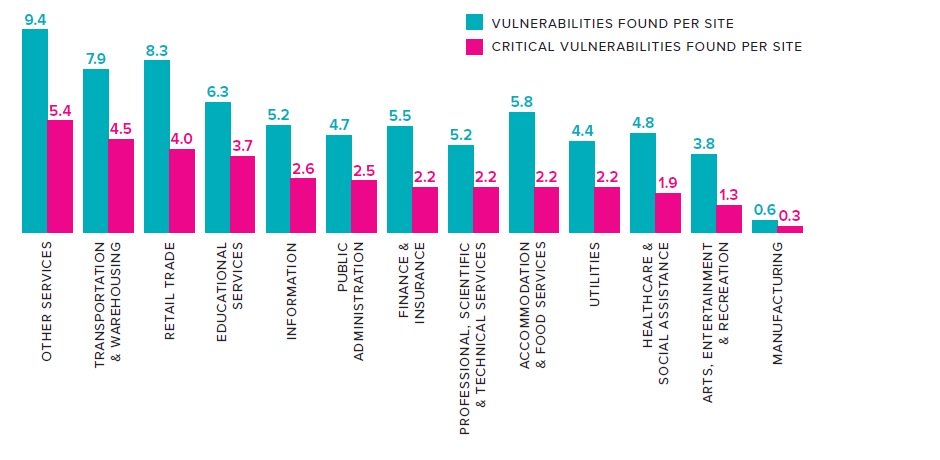
Data Breaches Can Cost Lives
Data is the life blood of today’s business world. If it is compromised or misused the consequences are far reaching.
Tim Cowell observes, “Some of our customers hold hugely sensitive data – government information, defence information, pharmaceutical data – which, if compromised, could have serious consequences. And the breach of even ‘standard’ data could be costly for our ‘regular’ business customers, in hard currency and in reputational damage.
Document Logistix recognises its obligation to ensure that the security of its products meet today’s risk challenges, so we invest in continuous review.”
Security: What else can an Application Vendor Do?
Is security a passive function? The answer should be “no.”
Tim Cowell wants to take the lead on product deployment and make stronger recommendations to customers about security housekeeping and management, even at basic levels, such as password strength and password sharing.
“Our products provide comprehensive audit trails on system access and user activity. There are relatively simple things we can do to advise customers on ways to do more to help themselves, and to help them to preserve the embedded security of features that they have purchased from Document Logistix.
It’s just one of those things that people do not give proper attention to until after an event, so it’s our job to help them to keep security ‘front of mind’.”