
Why compliance still feels complicated many years after regulation was introduced
By now, most organisations are well aware of data privacy regulation and compliance requirements. The General Data Protection Regulation (GDPR) has been in force since 2018. The Health Insurance Portability and Accountability Act (HIPAA) has shaped healthcare data protection in the United States for decades. The California Consumer Privacy Act (CCPA) has been active since 2020.
Compliance is no longer a new concept. Boards at every company discuss it. Company policies reference it. Staff receive training on it.
And yet, in practice, managing document compliance remains surprisingly complicated for many organisations.
Why? Because awareness is one thing. Operational control is entirely another thing.
Everyone knows that compliance matters; however, not everyone has control of their documents.
Lack of data centralisation and visibility
Most businesses today understand that personal data must be protected. They know individuals have rights of access, correction and deletion. They know fines can be severe. They know regulators expect accountability.
The difficulty lies in execution.
Personal data rarely lives in one tidy database. It sits inside:
- Contracts and agreements
- HR files
- Email chains
- Scanned supplier invoices
- Customer correspondence
- Paper archives
- Cloud folders accumulated over years
Even organisations that have invested in digital transformation often find that their document landscape is fragmented. Shared drives sit alongside legacy systems. Paper files coexist with cloud repositories. Automated workflows are used in some departments, while others rely on manual processes.
When a subject access request arrives or an internal audit begins, that data fragmentation becomes painfully visible.
The regulations haven’t changed. The operational challenge remains.
Under GDPR and similar laws, organisations must be able to:
- Identify where personal data is held
- Demonstrate lawful processing
- Restrict access appropriately
- Provide data in response to access requests
- Correct or delete information when required
- Retain records only for as long as necessary
On first reading, these requirements seem manageable. In reality, to be effective they require visibility across every document system and every workflow.
Take the “right to be forgotten” under GDPR. Deleting a record from a CRM is straightforward. Ensuring that the same individual’s details do not remain buried in archived emails, scanned PDFs or historic contracts is far more complex.
The issue is not a lack of awareness. It is infrastructure.
For guidance on regulatory expectations in the UK, the Information Commissioner’s Office remains a useful reference point.
Paper still counts – and so do legacy systems
Years after GDPR’s introduction, some organisations still underestimate one crucial point: paper documents are fully in scope.
Structured filing systems, even physical ones, fall under regulatory requirements. An HR cabinet containing employee records must be governed just as carefully as a cloud database.
Likewise, legacy document storage systems that lack robust indexing, access control or audit trails create hidden compliance risks. Unsurprisingly, as they were not designed with modern privacy regulation in mind.
As businesses grow and systems evolve, documents accumulate. Without a deliberate strategy, governance becomes reactive rather than controlled.
Automation helps – but only when it’s designed with compliance in mind
Many organisations have implemented workflow automation to improve efficiency. Invoice approvals, HR onboarding and contract reviews may already be fully digitised.
However, not all automated workflows are built around compliance principles.
True regulatory alignment in workflows requires:
- Role-based access controls
- Full audit trails
- Controlled document versioning
- Secure archiving
- Defined retention schedules
- Automated deletion (data purge) rules
Under HIPAA, for instance, access to protected health information must be tightly controlled and traceable. Under GDPR and CCPA, organisations must demonstrate accountability and “privacy by design”.
Automation can support an organisation’s data privacy objectives, but only if document management is structured and centralised. Automating a flawed or fragmented processes simply accelerates risk.
Extended responsibility in a cloud-first world
Another area in which compliance remains complicated is third-party management.
Many organisations now rely on cloud providers, scanning bureaus or outsourced document processing services. While outsourcing improves flexibility, it does not remove responsibility.
If a supplier mishandles personal data, liability can still rest with the original organisation.
Years after GDPR invalidated earlier data transfer mechanisms such as “Safe Harbor”, cross-border data management remains a sensitive area. Contracts, due diligence and technical safeguards must fulfil the requirements of regulatory standards.
Effective compliance requires ongoing governance, not a one-off compliance project.
Why compliance still feels like a moving target
Even though GDPR, HIPAA and CCPA are established frameworks, the interpretation and enforcement of these regulations continue to evolve. Case law develops. Regulatory guidance is updated. Fines make headlines.
At the same time, businesses continue to generate more data than ever before. Remote working, collaboration tools and cloud platforms have multiplied document touchpoints.
The volume of personal data embedded within documents has increased dramatically. So has the complexity of managing it.
For many organisations, the gap between policy and practice becomes evident only when a regulator asks difficult questions, or when a data breach occurs.
Moving from awareness to operational control
The organisations that manage compliance effectively are not necessarily those with the thickest policy manuals. They are the ones with visibility.
A structured document management and workflow system enables businesses to:
- Locate personal data quickly across all departments
- Apply consistent indexing and metadata
- Restrict access according to role
- Track every document interaction through audit logs
- Enforce retention and deletion policies automatically
- Respond confidently to subject access requests
Instead of scrambling to piece together information from disparate systems, compliance becomes embedded within everyday processes.
How Document Logistix helps simplify compliance complexity
At Document Logistix, we recognise that most organisations understand their regulatory obligations. The challenge is implementing them consistently across document-based processes.
Our document management and workflow automation solutions help to centralise information, standardise processes and embed compliance controls directly into daily operations.
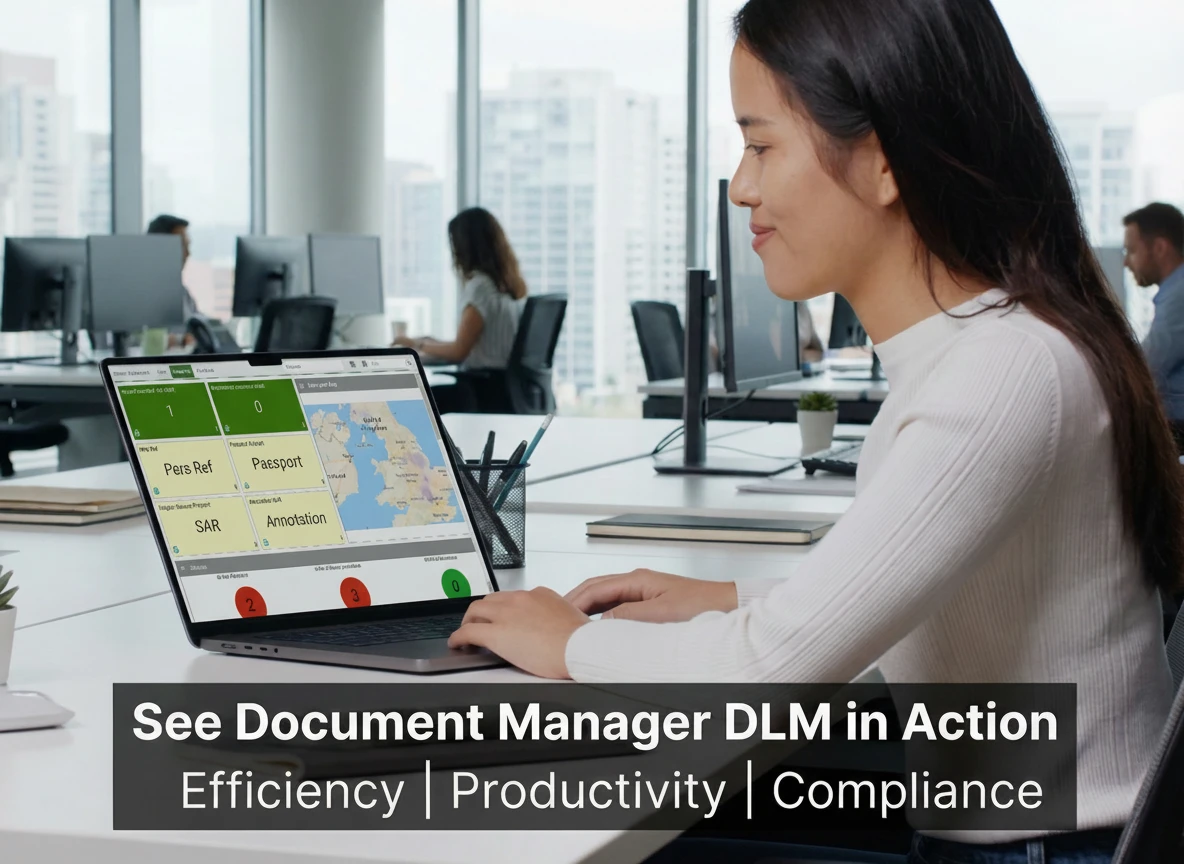
Document Manager delivers secure storage, granular access permissions, searchable archives, and automated retention and purge rules – all of which work together to reduce risk and administrative burden.
Another great benefit of a document management system like Document Logstix’ Document Manager is that approved users can search for all information relating to a subject instantly, across all data formats, in a secure central store.
Therefore, Document management systems significantly cut the time it takes to fulfil a subject access request (SAR). Addionally, built-in redaction tools enable the respondent to remove the data of people unrelated to the requestor or subject of interest.
The reality of compliance today
Years after GDPR and similar regulations reshaped the world of data privacy, compliance is no longer a new initiative. It is a permanent feature of business operations.
Yet for many organisations, document management remains a weak link.
The lesson is clear: awareness is widespread, but operational discipline requires the right systems.
Managing compliance does not have to feel overwhelming. With structured document control and intelligent automation, compliance management becomes less about firefighting and more about governance, and is reliable, visible and defensible.
In today’s regulatory environment, that level of control is essential.
See how Document Manager supports compliant document strategies >>>
The most common compliance issues departments face
In our experience at Document Logistix, compliance challenges arise from fragmented processes and legacy habits. Departments frequently struggle with inconsistent document storage, where critical records sit across shared drives, inboxes and paper files with no unified structure. Fragmentation makes responding to subject access requests slow and stressful.
Access control is another recurring issue. Sensitive HR, finance or healthcare documents are sometimes visible to more staff than necessary, which increases risk. Retention is equally problematic, as many organisations either keep documents indefinitely or delete them without a clear audit trail.
Finally, limited visibility into automated workflows can create uncertainty. Without clear logs and version control, demonstrating accountability under regulations such as GDPR, HIPAA or CCPA becomes far more difficult than it needs to be.
FAQs: Document Compliance and Regulatory Impact
Do GDPR, HIPAA and CCPA apply to internal documents?
Yes. If a document contains personal data, whether it is a contract, email or scanned form, it falls within scope.
Are paper records included in compliance requirements?
Absolutely. Structured paper filing systems are covered under data protection regulations.
Is cloud storage automatically compliant?
No. Responsibility remains with your organisation. Providers must be assessed and governed appropriately.
How can document management software help?
A structured system centralises storage, controls access, enforces retention rules and creates audit trails, which makes compliance demonstrable rather than theoretical.
Is compliance a one-off project?
No. It is an ongoing operational discipline that should be embedded into everyday document workflows.