
How Much Does Document Management Software Cost?
For most organisations considering document management software, the first question is usually the simplest.
How much does it cost?
The better question is often:
What is the cost of continuing without document management?
Looking only at software licence fees rarely tells the full story. The real financial picture includes the time employees spend searching for information, duplicated documents, manual data entry, compliance risks, storage costs, security vulnerabilities and the delays caused by disconnected systems.
Whether your organisation still relies on paper files, operates with shared network drives or uses a mixture of cloud storage, email and filing cabinets, every document has a cost attached to it. Some costs are obvious. Others remain hidden until they become expensive problems.
This guide examines document management software costs from every angle, including implementation, ownership, productivity, compliance and return on investment. It explains why many UK organisations find that the largest expense is not buying document management software but delaying it.
Why Cost Isn’t Just About Software
When comparing suppliers, many businesses focus on monthly subscription prices.
While software pricing matters, it represents only one part of the overall investment.
A document management system (DMS) should be viewed as business infrastructure rather than another IT expense. Like accounting software or an ERP system, it supports every department including finance, HR, procurement, legal, operations and customer service.
The objective is not simply to store documents electronically. Modern systems centralise information, automate routine business processes and strengthen governance across the organisation.
These process improvements affect operational costs every day.
Typical Document Management Software Costs
Costs vary according to organisation size, number of users, storage requirements and automation capabilities.
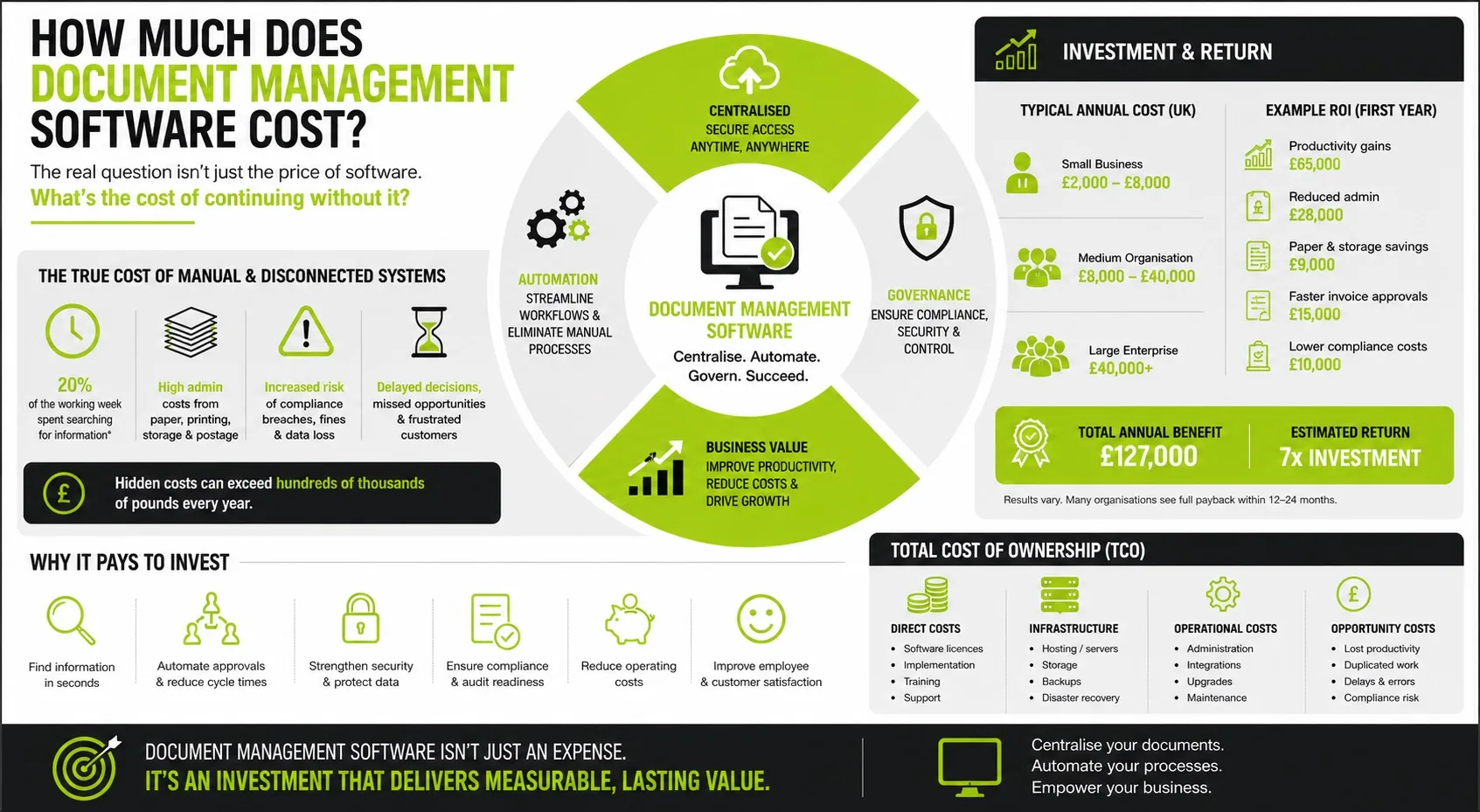
Typical UK pricing ranges include:
| Organisation Size | Typical Annual Cost |
| Small business | £2,000–£8,000 |
| Medium-sized organisation | £8,000–£40,000 |
| Large enterprise | £40,000+ |
Implementation costs may include:
- System configuration
- User training
- Data migration
- Workflow design
- Integration with existing business systems
- Security configuration
Cloud-based Software as a Service (SaaS) solutions generally have lower upfront costs than traditional on-premises installations, while they also reduce infrastructure and maintenance requirements.
The exact investment depends on the level of automation required. A simple electronic filing system costs considerably less than a fully integrated platform that automates invoices, contracts, HR records and business workflows.
What Determines the Price of Document Management Solutions?
Several factors influence overall costs.
Number of System Users
Most suppliers price either per named user, concurrent user or organisation-wide licence.
Larger organisations often negotiate enterprise pricing.
Document Volumes
Processing one thousand invoices each month requires very different infrastructure from processing one hundred thousand.
Higher document volumes generally increase storage and automation requirements.
Process Automation
Automation significantly changes the value equation.
Features such as:
- Intelligent document capture
- Optical Character Recognition (OCR)
- AI document classification
- Automated approvals
- Workflow routing
- Retention management
Automation capabilities can increase implementation costs but frequently produce the fastest financial returns.
Systems Integration
Connecting document management software with Microsoft 365, ERP systems, finance platforms, CRM systems and HR software requires additional implementation work.
However, integrations often eliminate duplicate data entry and reduce administrative effort.
In the case of Document Logistix, integration with leading business systems is available at the outset.
The Hidden Cost of Manual Document Management
Most organisations underestimate how much manual document handling costs.
Research by IDC has estimated that knowledge workers spend around 20% of their working week searching for information. Other studies suggest employees can spend several hours each week locating documents, recreating missing files or waiting for approvals.
Consider a business employing 100 office staff.
If each employee spends just 30 minutes per day searching for documents:
- 50 hours are lost every working day
- around 250 hours each week
- over 13,000 hours each year
At an average employment cost of £30 per hour, that equates to almost £390,000 annually in lost productivity.
Most businesses experience additional hidden costs through:
- duplicated documents
- inconsistent version control
- repeated data entry
- paper storage
- courier costs
- printing
- scanning
- misplaced information
- delayed customer responses
- longer audit preparation
None of these costs appear on a software quotation, yet they often exceed software costs many times over.
The Cost of Hybrid Management Systems
Many organisations believe they have already digitised their documents.
In reality, they operate hybrid environments.
Information may exist across:
- paper archives
- shared drives
- SharePoint
- cloud storage
- ERP systems
- local PCs
- department-specific databases
This hybrid environment creates fragmentation.
Employees spend time deciding where information might be instead of knowing where it is.
Hybrid environments also increase:
- duplicate records
- inconsistent retention
- access control problems
- security risks
- compliance challenges
Centralisation removes these process inefficiencies.
The Cost of Disconnected Systems
Disconnected systems introduce another layer of expense.
A purchase invoice may arrive by email.
Someone downloads it.
Another employee uploads it.
Finance manually enters supplier information.
An approver receives another email.
The signed document is stored somewhere else.
Each manual step introduces delay and opportunities for error.
Automation replaces these disconnected activities with a single controlled workflow.
Documents move automatically.
Approvals are recorded.
Audit trails are generated.
Information remains searchable throughout its lifecycle.
Measuring Risk as Part of Cost
Cost should never be measured purely in pounds.
Risk carries financial consequences.
Poor document governance increases exposure to:
- GDPR breaches
- lost customer information
- failed audits
- regulatory penalties
- litigation
- fraud
- cyber attacks
- accidental deletion
According to IBM’s Cost of a Data Breach Report, the average global cost of a data breach exceeded US$4 million in recent years, with detection and response remaining major contributors. Strong information governance reduces both the likelihood and impact of security incidents.
Even relatively small compliance failures can lead to reputational damage that far exceeds any software investment.
Centralisation: The Foundation of Lower Document Management Costs
One of the greatest financial benefits comes from centralisation.
Rather than documents being scattered across multiple repositories, they are managed within a single controlled environment.
This delivers measurable improvements including:
- faster search
- stronger security
- consistent version control
- simplified compliance
- reduced duplication
- easier collaboration
- better disaster recovery
Employees spend less time managing documents and more time performing productive work.
Automation Reduces Operational Costs
Automation removes repetitive administrative work.
Common examples include:
Accounts Payable
Invoices are captured automatically.
Data is extracted using AI and OCR.
Approvals follow predefined workflows.
The ERP updates automatically.
Processing costs fall while payment accuracy improves.
Human Resources
Employee records are securely stored.
Documents follow retention policies automatically.
Managers receive reminders when documents require review.
Contracts
Expiry dates trigger notifications.
Approvals are automated.
Version control prevents outdated agreements from being used.
Customer Correspondence
Incoming documents are classified automatically and routed to the correct team.
Customers receive faster responses while staff spend less time sorting paperwork.
Governance Creates Long-Term Value
Governance is often overlooked during purchasing decisions.
It should not be.
Strong governance provides:
- retention policies
- audit trails
- permission-based access
- encryption
- version history
- automated disposal
- compliance reporting
These document management capabilities reduce organisational risk while making regulatory compliance significantly easier.
Governance also supports ISO 27001, GDPR and industry-specific regulatory requirements.
Understanding Total Cost of Ownership (TCO)
The purchase price represents only a fraction of overall ownership costs.
A proper Total Cost of Ownership (TCO) assessment should include:
Direct Costs
- software licences
- implementation
- migration
- training
- support
- maintenance
Infrastructure Costs
- servers (if on-premises)
- cloud hosting
- storage
- backups
- disaster recovery
Operational Costs
- administration
- upgrades
- integrations
- workflow maintenance
- security monitoring
Opportunity Costs
Opportunity costs are perhaps the largest but least visible costs.
These include:
- staff searching for documents
- delayed decision making
- duplicated work
- compliance failures
- customer dissatisfaction
- slower onboarding
- longer invoice processing
- missed early payment discounts
When organisations calculate TCO properly, manual document management frequently proves to be the more expensive option.
Calculating Return on Investment (ROI)
Return on Investment should be measured across several categories rather than relying on one headline figure.
Productivity
Measure:
- hours saved
- reduced manual processing
- faster document retrieval
- quicker approvals
Financial Savings
Include:
- reduced paper usage
- lower physical storage costs
- fewer printing costs
- reduced courier charges
- lower archiving costs
Compliance
Estimate reductions in:
- audit preparation time
- regulatory risk
- legal exposure
- data loss incidents
Customer Experience
Measure:
- faster response times
- improved service quality
- reduced complaints
- quicker onboarding
Employee Satisfaction
Removing repetitive administration enables employees to focus on higher-value work, which contributes to improved engagement and retention and reduces frustration levels.
Example Document Management ROI Calculation
Suppose a business has:
- 75 employees
- 25,000 documents processed each year
- manual invoice approvals
- paper HR files
- multiple shared drives
Annual software investment: £18,000
Estimated annual savings:
- Productivity improvements: £65,000
- Printing and storage: £9,000
- Reduced administration: £28,000
- Faster invoice approvals: £15,000
- Lower compliance costs: £10,000
Total annual benefit: £127,000
Estimated first-year return: More than seven times the original investment.
Actual results will vary but many organisations recover implementation costs within the first 12 to 24 months through productivity gains alone.
Questions to Ask Before Comparing Prices
Instead of asking only:
“How much does the software cost?”
consider asking:
- How much time do employees spend searching for documents?
- How much manual data entry could be automated?
- What is our current compliance risk?
- How much do paper storage and archiving cost?
- How much duplication exists?
- How many approval delays occur every week?
- What would happen if key documents became unavailable?
These questions often reveal that the cost of inaction is significantly higher than the investment itself.
Choosing the Right Solution
The lowest-priced solution is rarely the cheapest over its lifetime.
Look for software that provides:
- centralised document storage
- intelligent automation
- secure governance
- integration with existing systems
- scalable architecture
- straightforward administration
- strong vendor support
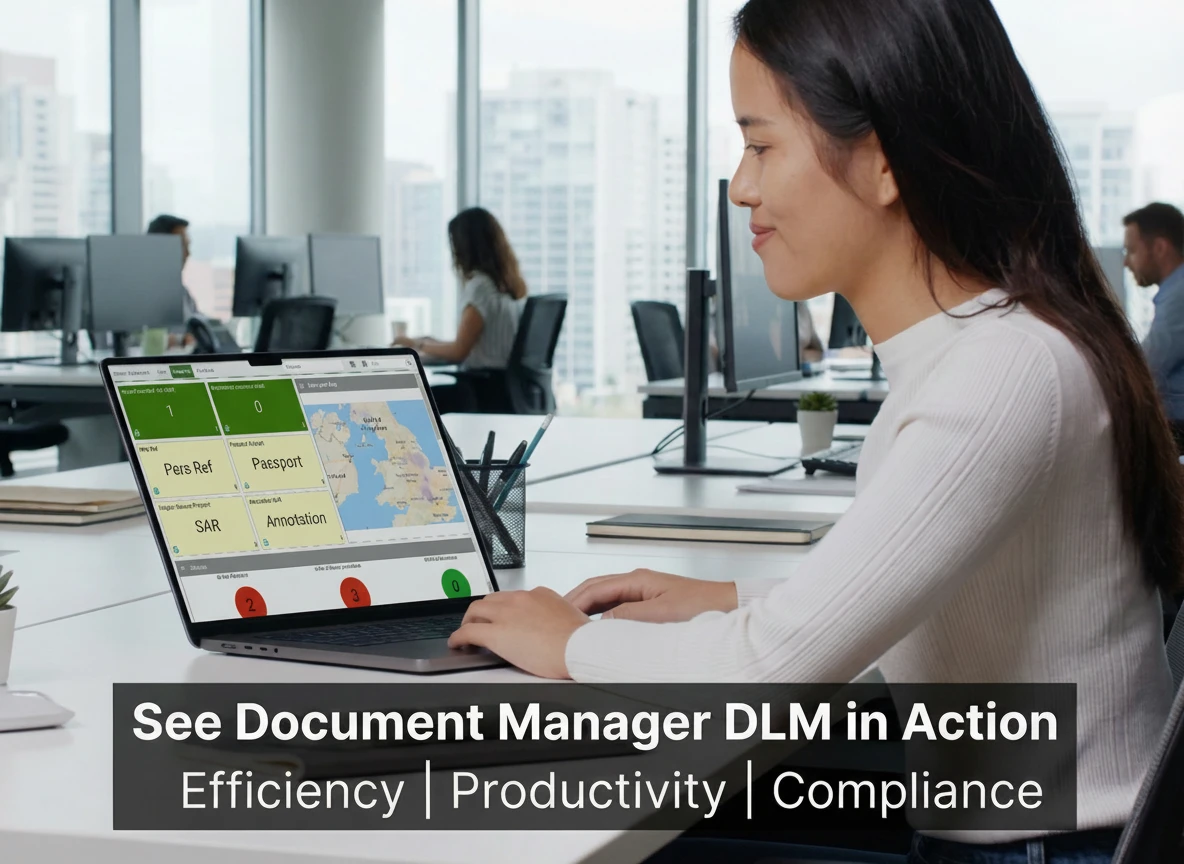
A platform that grows with your organisation usually delivers better long-term value than one requiring replacement after only a few years. Check out our own multi-award winning document management solution, Document Manager and ask for a demonstration >>>
Conclusion
Document management software is often viewed as a technology purchase. In reality, it is an operational improvement programme.
Document management software value extends beyond storing files electronically. It centralises business information, automates repetitive processes and strengthens governance across the entire organisation.
When organisations evaluate costs accurately, they quickly discover that licence fees are only one part of the equation. The ongoing expense of manual processes, fragmented systems, compliance risks and lost productivity can be substantially greater.
Viewed through the lens of Total Cost of Ownership and Return on Investment, document management software becomes less about expenditure and more about creating measurable business value. For many organisations, the question is no longer whether they can afford to invest in document management but whether they can afford not to.
Frequently Asked Questions
How much does document management software cost in the UK?
Costs typically range from around £2,000 per year for small organisations to £40,000 or more for larger enterprises, depending on users, storage, automation and integrations.
Is cloud document management cheaper than on-premises?
Cloud solutions generally require lower upfront investment and reduce infrastructure, maintenance and upgrade costs, which makes them more cost-effective for many organisations.
What is the biggest hidden cost of poor document management?
Lost employee productivity is often the largest hidden expense. Time spent searching for documents, recreating missing information and managing manual processes can far exceed the cost of software.
How quickly can organisations see a return on investment?
Many organisations begin seeing measurable benefits within the first year through productivity improvements, reduced paper handling and faster business processes. More complex projects may take longer but can deliver greater long-term returns.
What features provide the greatest financial value?
Centralised document storage, automated workflows, AI-powered document capture, robust search, audit trails, retention management and seamless integration with existing business systems typically deliver the strongest operational and financial benefits.