
AI in Document Management
Artificial intelligence has become one of those phrases that can mean almost anything. This is doubly the case when applied to AI in document management.
Ask ten people what AI means and you are likely to get ten different answers. For some, it means ChatGPT and generative AI. For others, it means machine learning, predictive analytics, computer vision or automated decision-making.
In document management, AI can mean something as practical as recognising an invoice and extracting its key information, or something considerably more sophisticated: asking questions of thousands of documents and receiving an intelligent answer in seconds.
There is no single definition of AI and, importantly, there is no single way of applying it.
What matters in business is not whether a system carries an impressive AI label. What matters is whether the intelligence is useful, safe, accurate and capable of solving a genuine problem.
Practicability is increasingly the direction in which document management is moving.
For decades, document management was largely about putting information somewhere safe and making it possible to find it again quickly. That remains important, but it is no longer enough. The modern organisation wants its information to do more. It wants documents to be understood, relationships between information to be identified, routine decisions to be supported and actions to happen automatically.
The underlying trend in AI is therefore a move from static document management towards dynamic information management – and from standalone functions towards business agility.
AI in document management: how did we get here?
AI in document processing is not actually new.
OCR, automated indexing, computer vision, machine learning and rules-based workflow have been developing for many years. Document Logistix, for example, has already used AI and machine learning with its Document Manager platform and Lemmana technology to recognise, classify and extract information from documents, while automatically routing information into the appropriate workflow. Document Logistix has won the Robotic Process Automation of the Year award on several occasions.
The pandemic accelerated the wider move towards digital documents and remote working, which exposed the weaknesses of paper-based and manually controlled processes. Since then, the arrival of commercially useful generative AI and large language models has changed expectations again.
The significant development over roughly the last three to four years has been the move from AI that processes documents to AI that can understand and interrogate them.
That distinction is important.
Traditional automation might recognise an invoice number, supplier name and value. Generative AI can potentially look across a collection of invoices, identify unusual patterns, explain discrepancies and answer questions about what has happened.
The document is no longer simply something to be stored or processed. It becomes a source of business intelligence.
What are other document management companies doing?
The wider document management industry is moving in the same direction.
Microsoft, for example, has introduced AI-powered agents within SharePoint that can answer questions about content held in sites and document libraries, subject to the user’s permissions. Users can also create agents around particular sources of business information.
OpenText has taken a similar approach with Content Aviator, to position AI as an assistant that can understand business content and context, answer questions, analyse information and support processes while retaining access controls, retention policies and audit trails.
Other organisations have moved into what they call intelligent and agentic document processing. Their technology combines AI-powered capture, classification, extraction and enrichment with generative AI and AI agents capable of handling exceptions and extending automation into wider business processes.
This tells us something important about where the market is heading.
The competition is no longer simply about who has the best filing system, OCR engine or search facility. It is increasingly about who can turn an organisation’s information into something that can be understood, analysed and acted upon.
So, what does ‘good AI’ actually mean?
This is where some of the excitement surrounding AI needs to be tempered with common sense.
Good AI in document management should not be about replacing people for the sake of replacing people. Nor should it be about producing impressive demonstrations that have little practical value once the technology is deployed.
Effective AI should make work quicker, simpler, more accurate and more useful.
It should understand the context of information rather than merely recognise words. It should work with the information an organisation is actually permitted to use. It should provide answers that can be trusted and, where appropriate, checked. It should respect strict security, permissions, retention and compliance arrangements.
Above all, AI should improve the quality of a business decision or remove unnecessary work without creating a new risk elsewhere.
That is the artificial intelligence philosophy behind the next stage of development for Document Logistix’ Document Manager.

From searching for documents to interrogating information
Free-text search remains extremely useful. If you know that you are looking for a particular document, keyword or phrase, searching is quick and effective.
AI interrogation is different.
Imagine opening a drawer containing hundreds of documents and being able to ask: What are the recurring complaints from these customers? Which contracts contain unusual termination clauses? Are there discrepancies between these invoices and the agreed terms? What changed between this year’s records and last year’s?
The document management system is no longer simply finding documents containing particular words. It is interpreting the information contained within them.
Document Manager’s emerging AI capability takes this concept to drawer level. Users can interrogate collections of information assets rather than necessarily dealing with documents one at a time.
Those information assets do not have to be conventional Word or PDF documents. Depending on the content being managed, they can include scanned documents, electronic files, video and audio.
The output is an intelligent, interpretative summary rather than a line-by-line transcript.
And that opens up considerably more possibilities.
The same information can be used for fault analysis, gap analysis, customer insight, exception handling, trend spotting and strategy development. It can also support risk assessment, GDPR compliance reviews, root-cause analysis, supplier performance analysis, claims investigation, policy reviews, knowledge discovery, service improvement, forecasting, quality assurance and management reporting.
In other words, the business value of AI is not necessarily in summarising the document. The value is in understanding what the document means in the context of the organisation.
One second to analyse thirty pages
We have become accustomed to the speed of consumer AI. Nobody is particularly surprised when an AI system produces an answer in seconds.
Business information has traditionally worked at a different pace.
A complex 30-page legal document can take a person considerable time to read, understand and summarise. Document Manager’s AI can summarise such a document in around a second.
That does not mean the lawyer, HR professional or finance manager becomes unnecessary. Quite the opposite.
The professional can spend less time performing the mechanical task of reading and summarising and more time considering what the information means and what should happen next.
This is an important distinction. The objective of AI in document management is augmentation rather than blind replacement.
Where could new processing speeds make a difference?
Consider HR.
An organisation might have years of employee documentation, policies, correspondence, absence records, grievances and other information. AI can help identify recurring themes, gaps in documentation or patterns that deserve attention.
Customer Services offers another obvious application. A business may have hundreds or thousands of complaints. Rather than treating every complaint as an isolated event, AI can help identify common causes, recurring service failures and emerging customer concerns.
Finance presents another opportunity. AI can help identify discrepancies, unusual transactions, inconsistencies between documents or exceptions that deserve human review.
Legal and contract management may be even more significant. Organisations can interrogate contracts for particular clauses, obligations, dates, risks or inconsistencies rather than relying entirely on manual document-by-document examination.
And these are only the starting points.
The same AI capability can support insurance claims analysis, procurement reviews, supplier management, quality control, investigations, regulatory compliance, business continuity planning, research and development, and management decision-making.
From advisory intelligence to business value
At this stage, AI findings should generally be regarded as advisory.
That is not a weakness. It is a sensible way to introduce AI into important business processes.
AI can provide a view of what may be happening, highlight something unusual or point towards a potential future development. A person can then decide whether the finding warrants action.
The next stage is more interesting.
As AI becomes embedded into controlled workflows, findings can increasingly trigger business processes. An identified discrepancy could initiate an investigation. A contract approaching renewal could generate a workflow. A recurring customer complaint could trigger a service review. A compliance issue could be escalated automatically. A purchasing pattern could highlight an opportunity to renegotiate with a supplier.
Eventually, the value extends beyond saving administrative time.
AI becomes part of how organisations generate revenue, protect margin, retain customers and manage risk.
That is the real opportunity when deploying AI in document management.
Continuous AI rather than one-off questions
Another important development is that Document Manager’s AI capability is designed to provide conversational, context-aware interaction.
Rather than treating every question as an isolated event, the system can retain the context of the interaction and build on previous questions and answers.
A useful term for this is conversational continuity or contextual memory.
Continuity matters because business questions rarely exist in isolation.
A manager might first ask what the principal customer complaints are, then ask which customers are most affected, then ask whether those complaints increased during a particular period and finally ask which underlying documents support the conclusion.
The conversation becomes a progressively deeper investigation rather than a series of unrelated searches.
The quieter AI revolution: capture and routing
Not all AI developments will be as visible as asking a question of a document collection.
There is also considerable value at the point where information first enters an organisation.
Document Manager and Lemmana already demonstrate this approach. Information can arrive through email, uploads or scanning and AI and machine learning can recognise document types and content, extract relevant information and route documents to the appropriate location, person, department, review process or approval workflow.
This is important because effective AI document management is not simply about what happens after a document has been filed.
Effective AI document management is about creating an intelligent information journey from ingestion to action, storage, retention and eventual disposal.
Productivity, errors and ROI
The commercial case for AI in document management ultimately comes down to a fairly simple question: what does AI save and what does it enable?
If an employee spends ten minutes finding, reading and summarising a document and AI reduces that task to seconds, the time saving is obvious. Multiply that across hundreds or thousands of documents and the potential becomes substantial.
There are other savings too.
Automated capture reduces manual data entry. Automated routing reduces administrative handling. Intelligent classification reduces misfiling. AI-assisted checking can identify discrepancies that might otherwise be missed. Faster access to information shortens customer response times and accelerate decisions.
The return on investment will vary enormously between organisations, so claims of a universal AI ROI figure should be treated cautiously.
The sensible calculation is to measure your organisation’s own baseline: staff hours, processing volumes, error rates, response times, storage costs, compliance exposure and the financial consequences of delays or mistakes.
After reviewing your current business metrics, AI becomes measurable rather than fashionable.

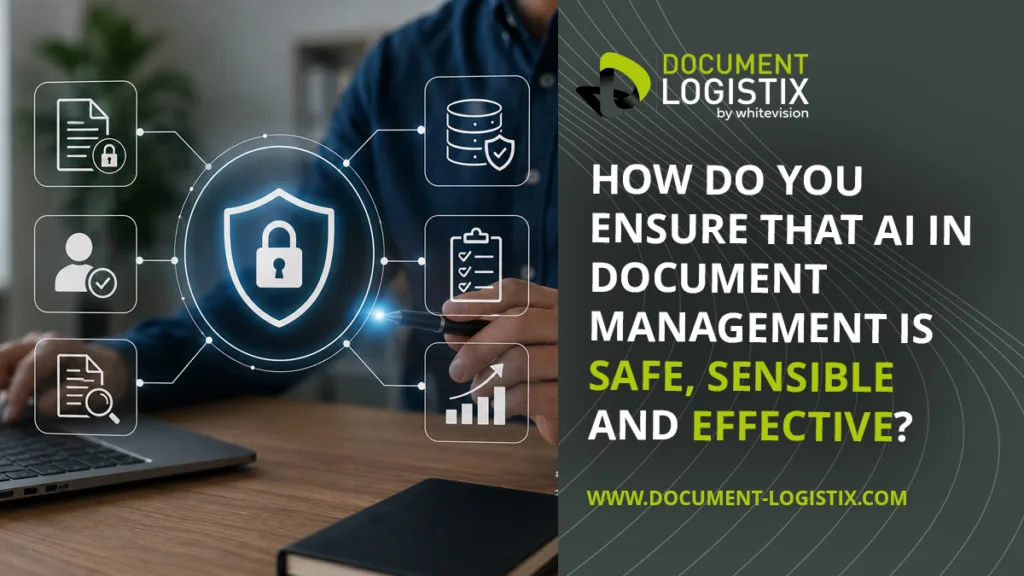
But is AI safe?
This is perhaps the most important question of all.
Document Logistix works across many industries, including sectors in which documents can contain highly sensitive personal, financial, legal and operational information.
Customers quite rightly expect innovation. They also expect that innovation to be demonstrably safe.
The objective should therefore be safe, sensible and effective AI.
Speed is useful. Intelligence is useful. Automation is useful. None of them matters if confidential information is exposed or regulatory obligations are compromised.
Data privacy, access control, auditability, retention and compliance therefore have to remain fundamental. AI should operate within the organisation’s information governance framework rather than becoming a parallel system outside it.
This is particularly important as AI becomes capable of drawing conclusions from multiple documents. The more powerful the interrogation capability becomes, the more important it is that users can only interrogate information they are authorised to access.
The AI direction being taken by Document Logistix reflects this safety concern: access controls, encryption, audit trails and retention policies underpin Document Manager’s AI interactions.
Conclusion
The story of AI in document management is not really a story about robots taking over filing cabinets.
It is a story about information becoming dynamic.
The first generation of digital document management largely solved the problem of where information was stored. The next generation solved the problem of how it could be found and moved through workflows. AI is beginning to address a much bigger question: What can an organisation actually understand and do with all that information?
That is your opportunity with Document Logistix.
Document Manager’s development is moving beyond conventional search and automation towards intelligent interrogation, contextual understanding, analysis and increasingly connected business processes.
The goal is not AI for AI’s sake.
The business goal is to make document management quicker, simpler, more accurate and more valuable while maintaining the security, privacy and governance that businesses cannot afford to compromise.

What to expect
The direction of travel is clear.
Expect document management to become increasingly conversational. Instead of searching for the right document, users will increasingly ask the system the right question.
Expect AI to work across collections of information rather than isolated files.
Expect greater use of historical information to identify trends, exceptions and opportunities.
Expect AI findings to move progressively from advisory insight towards controlled automated action.
Expect document capture, classification and routing to become increasingly intelligent at the point information enters the organisation.
And expect the distinction between document management, workflow, business intelligence and AI to become increasingly blurred.
The document management system of the future is unlikely to feel like a filing system at all.
The document management system of the future will feel more like an intelligent business information layer – one that understands what the organisation knows, helps people find what matters and increasingly helps them decide what to do next.
For Document Logistix, that is the direction of travel: AI that is safe, sensible, effective and genuinely useful to the people who have to get work done.
FAQs
What does AI mean in document management?
AI in document management is an umbrella term covering technologies such as machine learning, natural language processing, computer vision, OCR and generative AI. They can be used to recognise, classify, extract, search, summarise, analyse and route information.
How is AI different from traditional document search?
Traditional search generally looks for words, phrases or metadata. AI interrogation can interpret the meaning and context of information, to enable users to ask questions about documents or collections of documents rather than simply searching for particular terms.
Can AI analyse more than text documents?
Yes. Modern document management environments increasingly need to deal with multiple information formats. Depending on the technology and implementation, AI can work with scanned documents, electronic files, images, audio and video.
Will AI replace document management staff?
The more practical expectation is that AI will automate repetitive tasks and augment human expertise. People remain responsible for judgement, interpretation and decisions, particularly when the consequences are significant.
Is AI safe for confidential business information?
It can be, provided it is implemented with appropriate security, permissions, governance, auditability and data protection controls. AI should not be treated as a reason to bypass existing information governance. In a properly designed system, security and compliance are part of the AI architecture.
What is the ROI of AI document management?
There is no universal figure. ROI depends on document volumes, staff time, error rates, processing costs and the value of faster decisions. The strongest business cases measure the organisation’s existing costs and then calculate the improvement produced by automation and AI.
What is the next major development in AI document management?
The industry is moving from document processing towards document understanding and increasingly towards AI-assisted action. The next step is not simply asking AI what a document says, but using trusted information to identify what needs to happen next – with appropriate human oversight and governance.