The General Data Protection Regulation Document Compliance: GDPR Records Compliance

How to embed effective GDPR governance in records & document management

GDPR document compliance introduction

The General Data Protection Regulation (GDPR) sets a robust framework for data protection to ensure individuals’ privacy rights are respected. Compliance is essential for organisations processing personal data within the EU and UK, or involving EU or UK residents.

GDPR document compliance entails implementing clear policies, securing data and providing transparency in data handling. Failure to comply risks penalties and reputational damage. A structured approach to document management, including data mapping, consent tracking and breach response plans is crucial for aligning with GDPR mandates.

Why is document compliance important?

Document compliance ensures that records meet legal, regulatory and industry standards, reducing risks of penalties and lawsuits.

Document compliance enhances data security, protects sensitive information and promotes transparency in business operations.

Regulatory compliance also streamlines audits, improves operational efficiency and fosters trust with stakeholders.

Proper documentation ensures consistency, accountability and adherence to best practices.

Document control is crucial for regulatory compliance by ensuring accurate, updated and accessible records, to prevent errors, support audits, maintain consistency and demonstrate adherence to legal, quality and industry standards effectively.

Ultimately, document regulatory compliance minimises legal liabilities, strengthens corporate reputation and supports organisational success by maintaining clear, accurate and accessible records.

GDPR document management compliance and records compliance automation

Records management and GDPR document compliance have been hot topics since the EU General Data Protection Regulation (GDPR) was introduced in 2018.

The GDPR directive posed a risk to businesses compared with previous versions as sanctions can be very high, up to four percent of a company’s worldwide turnover.

However, GDPR also provided organisations with an opportunity to review their data and information processes so that they work more efficiently and effectively for the company, its staff and customers.

If you have doubts about your GDPR document compliance, Document Logistix can help you with an audit to help make recommendations about adjusting data handling and automating processes.

For example, a retention protocol that enables organisations to capture, manage, retain and destroy electronic information automatically is straightforward and simple to implement as part of your GDPR document compliance strategy.

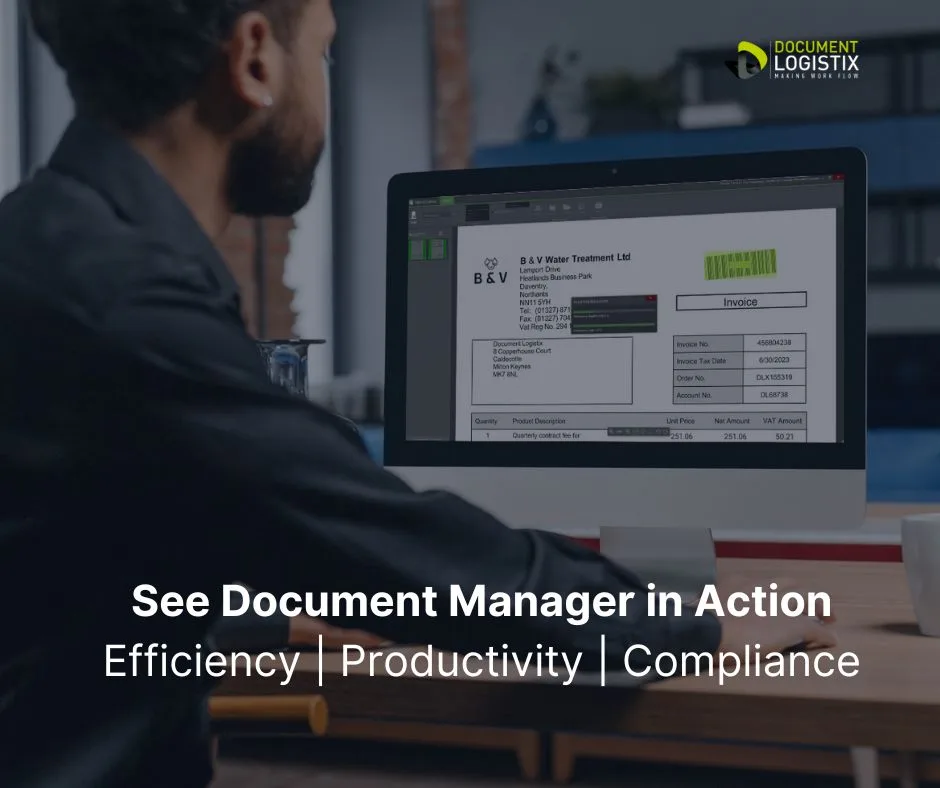
See GDPR document regulatory compliance in action >>>

What is document compliance?

Document compliance refers to the process of ensuring that documents meet specific legal, regulatory and organisational standards.

This includes adhering to industry regulations, data privacy laws and internal company policies.

Compliance involves proper formatting, content accuracy, security protocols and adhering to retention periods for documents.

It is crucial in regulated industries such as healthcare, finance and law to avoid legal liabilities, penalties, and reputational damage.

Document compliance also ensures data integrity, transparency and accountability within an organisation. Tools like GDPR document compliance management systems assist in maintaining compliance by tracking versions, approvals and updates throughout the document lifecycle.

The importance of risk assessments

Risk assessments are vital in document management to ensure regulatory compliance by identifying potential gaps, errors or security threats. Risk assessments help organisations to implement controls, prioritise risks and maintain accurate, secure and accessible records.

Risk assessments are an important part of taking a proactive approach that supports audit readiness, maintains information security, reduces the potential of non-compliance penalties, and ensures consistent alignment with legal, quality and industry standards across all documentation processes.

Is your document retention policy GDPR-compliant and enforceable?

Under GDPR organisations must track usage of records, files and documents. Tracking must include a documented understanding of why, where and how information is stored. 

GDPR also begs the question: do you have an enforceable retention policy?

A retention policy sets the time that information, data and records must be managed and retained, and ultimately deleted according to mandated time periods.

It provides a framework for employees on how they should manage information – from creation to destruction – to comply with data management and GDPR regulations.

A retention policy includes both paper and digital formats, which adds an element of complexity if a paper version has been printed and tucked away in a drawer.

Approaches to retention policy enforcement: manual or automated?

When individuals are left to monitor and enforce a retention policy, it involves significant manual intervention, time, effort and cost.

Alternatively, organisations that ruthlessly delete files that have reached their end of life (EOL), without any forewarning for staff, could potentially lose important records.

Neither approach is satisfactory.

Integrated document and records management is safest for GDPR compliance

Given that corporate data includes everything from employee information, client records, business accounting details to supplier emails – practically any data that is used for or generated in a business operation – adopting integrated document and records management processes is essential for GDPR document compliance.

GDPR document compliance crucial in particular industries

GDPR document compliance is crucial for all businesses and departments that handle personal data, and especially those in industries such as healthcare, finance, e-commerce, marketing and technology.

These sectors often process highly sensitive or large volumes of data, which makes adherence vital to protect individuals’ privacy and avoid fines, censure and reputational damage.

Departments like HR, IT, customer service and marketing face significant compliance responsibilities as they manage employee, customer or client data.

Ensuring proper documentation — such as data processing records, privacy policies and breach response plans — is essential to demonstrate accountability, manage risks effectively and maintain trust with stakeholders in an increasingly privacy-conscious landscape.

GDPR Data Retention and Purge (Data deletion)

When individuals are left to monitor and enforce a retention policy, it involves significant manual intervention, time, effort and cost.

Alternatively, organisations that ruthlessly delete files that have reached their end of life (EOL), without any forewarning for staff, could potentially lose important records.

Neither approach is satisfactory.

Examples of Document Retention Periods

Document retention periods vary by document type and industry regulations. Examples include:

  • Tax Records
    Typically retained for 7 years per IRS and HMRC guidelines.
  • Employee Records
    Kept for 3–7 years after termination.
  • Medical Records
    Retained for 5–10 years, depending on national and state laws.
  • Contracts
    Stored for 6–10 years after expiration.
  • Financial Statements
    Retained for 7 years.
  • Legal Documents
    Often permanently preserved.


Retention automation ensures compliance and protects organisations from legal risks.

Document Manager automates the retention and purge of any document type in any format.

Read Records Retention Periods: A Guide

Read Why Compliance is a Challenge in 2026

Can You Avoid Data Retention Breaches?

Records management has been a hot topic since the EU General Data Protection Regulation (GDPR) came into force in 2018.

The directive poses a risk to businesses compared with previous versions as sanctions can be up to four percent of a company’s worldwide turnover.

The more realistic results of data retention breaches are business disruption, internal costs and reputational damage. Nevertheless, GDPR retention issues pose a challenge for  organisations.

The good news is that a retention policy that enables organisations to capture, manage and destroy information automatically is relatively simple to achieve.

Automated indexing, retention and timely data purge

Document Logistix can help you to ensure that retention policies are applied automatically to physical files, electronic documents and unstructured data such as emails.

Our electronic document management system (EDMS) embeds good GDPR governance practices so that policies can be enforced in both controlled and uncontrolled environments, inside and outside the corporate firewall.

Automation of the document management system process also reduces the costs of managing information and enforcing a retention policy.

For assured GDPR document compliance, our system encrypts data, provides access controls and generates complete, time-stamped audit trails of activity.
A Complete Guide to Digital Document Management including GDPR document compliance


Document Manager
provides on-premises, Cloud and SaaS compliance options

Document Manager has been the trusted document management solution of small and large organisations for nearly 30 years. We have an in-depth knowledge of many industry sectors, including legal, manufacturing, logistics, professional services, finance and education.

Digitisation is a logical move for companies that are interested in digital transformation, that want to reduce the complexity surrounding information management, as well as GDPR document compliance.

Moving all or some of your documentation to the Cloud makes it far easier to collate and protect them, and to achieve permissions-based records management that is simple to audit.

Retention management is a natural extension of our Document Manager system, so it is seamlessly integrated into your day-to-day, month-to-month and year-on-year business workflow.

Integrated document and records management and automation make GDPR compliance less burdensome and costly to the business, and reduces the risk of penalties.

What are the consequences of not complying with GDPR? It’s not about the fines.

If you’ve never checked the size of fines for GDPR breaches, you’ll probably be amazed.  

However, focusing solely on fines is misleading, and can be seen as scaremongering.

In reality, regulatory bodies such as the ICO usually take a cooperative approach to correct compliance shortcomings.

At your organisation and ours, compliance best practices are not only about avoiding fines. The goal is to minimise the risk of data breaches, audit failures and reputational damage.

Yet, staying compliant can be resource-intensive, costly and time-consuming, especially with the rise in Subject Access Requests and the increasing complexity of data management.

Document Logistix experts talk to companies every day about GDPR document compliance. To find out more, please GET IN TOUCH.

This is how we can help you build compliance into your everyday GDPR document compliance processes:

Encryption

The document management system encrypts data in secure storage and in transit to guard against unauthorised access and data breaches

Permission-based access controls

Implement dynamic access controls at document management system, folder and file levels to ensure only authorised access.

Redaction tools

Redact (mask/hide) sensitive information to restrict access to authorised personnal, for example in contracts or HR documents.

Time-stamped audit trails

Audit logs of document management system activity improve the speed and accuracy of internal quality assurance and external audits.

Built-in document version control

Tracking changes and version control are essential to ensure that everyone is working with up-to-date information. Check-in/Check-out functions automate version control.

Automated data retention and purge

Managing retention periods manually is not practical. Document Manager automatically keeps and deletes records to comply with mandated retention periods.

System integration

Integrates with your current business systems and provides secure storage to achieve records centralisation, prevent duplication of effort and generate a unified approach. Centralise all documents, videos and photographs to enhance compliance.

Disaster recovery

Our document management system provides assured business continuity in the event of disruptions caused by fire or server outage.
GDPR document compliance records automation

Regulations to comply with UK and USA

In the UK, key compliance regulations include:

  • GDPR for data protection
  • The Companies Act for financial reporting
  • Health and Safety at Work Act for workplace safety.

In the USA, the main regulations include:

  • SOX (Sarbanes-Oxley Act) for financial transparency
  • HIPAA for healthcare data privacy
  • FCPA (Foreign Corrupt Practices Act) to combat bribery.

Both countries also enforce anti-money laundering (AML) laws and employment regulations to ensure business operations are ethical, safe and legally compliant.


Q&A for GDPR Document Compliance

Q1: What is the first step in achieving GDPR document compliance?

A:
The first step is conducting a data audit to identify and map all personal data the organisation processes. This includes understanding what data is collected, where it is stored, how it is used and who has access. This audit forms the foundation for creating compliant documentation and processes.

Q2: What documents are required for GDPR regulatory compliance?

A:
Key documents include a Data Protection Policy, Privacy Policy, Data Processing Agreements (DPAs), records of data processing activities (ROPA) and consent records. Organisations must also maintain breach response plans, data subject rights procedures and keep incident reports.

Q3: How can organisations ensure ongoing regulatory compliance?

A:
Ongoing compliance requires adopting an approach that involves continuous improvement, with regular training for staff, periodic audits of data practices and updates to policies as regulations or organisational processes change. Monitoring compliance and appointing a Data Protection Officer (DPO), if required, also helps maintain adherence to GDPR standards.

Document compliance case reference

A significant UK case highlighting document compliance is R (on the application of Jet2.com Ltd) v Civil Aviation Authority [2020] EWCA Civ 35.

The case revolved around the Civil Aviation Authority’s (CAA) failure to disclose documents related to regulatory discussions with Jet2.com.

The Court of Appeal ruled that public bodies must maintain transparency and comply with legal disclosure obligations, including the Freedom of Information Act 2000 and the GDPR.

The ruling emphasised that failure to document and disclose relevant records properly can lead to legal challenges, reputational damage and regulatory consequences.

This case reinforced the importance of robust document management policies and document control in ensuring regulatory compliance, accountability and trust in both public and private sector organisations.

 
Document Logistix
Document Logistix Limited 8 Copperhouse Court, Caldecotte Milton Keynes MK7 8NL United Kingdom
T +44 (0)1908 366 388
E info@document-logistix.com

Can we help?

We will help you to solve your business process challenges with secure centralised data and AI-powered workflow routing.

End-to-end document control and information flow

Would you like to know more, get in touch today