
Every business has them. The documents that someone knows exist but cannot find. The contract buried in an email chain. The latest version of a report that may, or may not, be in the shared folder. The invoice that needs checking before a payment can be approved. Or the policy that everyone assumes is up to date, although nobody is entirely sure when it was last reviewed.
Individually, these problems seem relatively harmless. A few minutes here, a quick message to a colleague there, perhaps a little frustration when a search produces dozens of possible answers. Most employees simply work around them and get on with their day.
But what happens when these small delays are repeated across an entire organisation, every working day?
The cost of finding information is often hidden in plain sight. It rarely appears as a separate item on a budget, yet it can affect productivity, customer service, decision-making, compliance and the ability of a business to respond quickly when circumstances change.
For organisations managing growing volumes of digital information, the question is no longer simply where to store documents. It is how to make sure people can find the right information, trust what they find and use it when they need it.
The everyday search for information is costing more than you think
It is easy to underestimate how much time people spend looking for information. After all, most employees would struggle to estimate how many times they search through folders, revisit emails or ask a colleague to send them a document.
Research from Microsoft offers a useful indication of the scale of the problem. Its 2023 Work Trend Index found that 62% of surveyed workers said they struggled with spending too much time searching for information during the working day. The research also found that 68% lacked sufficient uninterrupted time to focus on their work.
These figures come from Microsoft’s research into the modern workplace rather than a study of document management alone, but they highlight an important point: finding information competes with the work people are actually employed to do.
Read Microsoft’s Work Trend Index research
Think about what this means in practice. A finance manager looking for an approved purchase order is not processing invoices while searching. An HR professional trying to locate an employee record is not progressing recruitment or supporting managers. A project team waiting for the correct drawing or specification may be unable to move forward until somebody finds it.
The problem is not necessarily that employees are disorganised or that they lack digital skills. Often, the organisation has accumulated different systems, filing methods and working practices over many years. Documents are stored where it was convenient to put them at the time, rather than where they can be reliably found and managed throughout their working life.
Email becomes an informal archive. Shared drives grow into complicated networks of folders. Teams create their own repositories because the central system does not quite meet their needs. People save local copies because they want to be certain they can access a document later.
Before long, the business has plenty of information but no consistently reliable way of finding it.
How much does poor document management really cost?
The financial impact becomes clearer when you put some numbers against the problem.
Imagine a business with 200 employees who regularly work with digital documents. Suppose each person spends an average of just 10 minutes a working day searching for information, checking versions or asking colleagues for files.
That amounts to 33 hours and 20 minutes of working time every day across the organisation. Over 220 working days, the total reaches approximately 7,333 hours a year.
Now suppose the average employment cost, including salary and employer on-costs, is £25 an hour. The annual value of that time is approximately £183,000.
This is an illustrative calculation, not a claim that every business loses this amount. The actual figure will depend on the number of employees affected, the time they spend searching and their employment costs.
Nevertheless, it demonstrates why seemingly insignificant delays deserve attention. Even if only a proportion of this time could be recovered, the potential value could be substantial.
There is also an important distinction between the cost of time and the value of the work that time could otherwise have supported. An employee who spends less time searching may be able to deal with more customer enquiries, process more transactions, complete a project sooner or concentrate on a task that requires professional judgement.
Recovering that time does not automatically translate into an equivalent cash saving. It does, however, create capacity that a business can use more productively.
And this is only one part of the picture. The calculation does not include the cost of recreating lost documents, correcting mistakes caused by outdated information, delaying decisions or dealing with the consequences of a record that cannot be produced when required.
For many organisations, these indirect costs are at least as important as the time spent searching.
Why do digital documents become so difficult to find?
Digital transformation was supposed to make information easier to access. In many respects, it has. Documents can be shared instantly, accessed remotely and distributed across teams without the delays associated with physical files.
Yet digitisation alone does not guarantee effective information management.
In fact, the convenience of creating and storing digital files can make the underlying problem worse. It is so easy to save another copy, create another folder or send an attachment that organisations can accumulate information faster than they develop the processes needed to manage it.
Several familiar problems tend to emerge.
Documents are scattered across different systems
A supplier contract might be held in a shared drive, correspondence about its renewal in an employee’s inbox and a signed copy in a separate contract management application. The purchasing team may have a copy of the original order, while finance holds the invoices relating to it.
Each location may make sense in isolation. The difficulty arises when someone needs to understand the complete picture.
Employees then have to remember where information is likely to be stored, which systems they can access and who might have a copy. When a colleague leaves or a team changes its working practices, that informal knowledge can disappear.
Folder structures and file names are inconsistent
A folder system that works well for one department may be almost incomprehensible to another. Some employees use dates in file names, others use project references and others rely on descriptions that make sense only to the person who created the document.
Searching for a document called ‘Final Contract’ becomes particularly frustrating when there are several files with that name, each saved in a different location.
The issue is not that folders or file names are inherently unsuitable. They are useful tools. The problem is relying on them as the only means of organising and retrieving information when the volume and complexity of documents have grown beyond what a simple structure can comfortably support.
Nobody is quite sure which version is correct
Version confusion is more than an inconvenience. It can lead to people working from outdated procedures, using an obsolete specification or making decisions based on information that has already changed.
When documents are copied between systems, emailed as attachments and saved locally, it becomes harder to establish which version is authoritative.
A reliable document management approach should make it clear which record is current, who can amend it and, where necessary, what has changed. Version control and a clear audit history help replace guesswork with confidence.
Employees become the search engine
In many organisations, the quickest way to find a document is to ask somebody who has been there for years.
That person remembers the project, knows the naming convention and can probably recall which folder the team used before the latest system was introduced. This knowledge can be extremely valuable, but it also creates a dependency.
What happens when that person is on holiday, leaves the organisation or simply cannot remember?
Information should not depend on the memory of individual employees. A well-managed document environment makes it easier for people to find what they need without relying on informal networks of colleagues.
The risks go beyond wasted time
Poor document management is often treated as a productivity issue, but it can also create problems for information governance and compliance.
Businesses need to know what information they hold, why they hold it, who can access it and when it should be reviewed or disposed of. These responsibilities become harder to manage when documents are spread across disconnected repositories or retained without a clear purpose.
The Information Commissioner’s Office (ICO), which oversees data protection in the UK, explains that the UK GDPR’s storage limitation principle means personal data should not be kept for longer than necessary. Organisations should establish appropriate retention periods, review the information they hold and erase or anonymise personal data when there is no longer a valid reason to retain it.
The ICO’s guidance also makes clear that organisations need to be able to justify how long they keep personal data. A retention policy is useful, but having a policy on paper is not enough if the organisation cannot put it into practice.
Read the ICO’s guidance on storage limitation
Compliance assurance is where the quality of document management becomes particularly important. If records cannot be located reliably, it is harder to respond to requests, demonstrate that procedures have been followed or establish whether information has been retained appropriately.
The same applies when a business needs to investigate an incident, respond to an audit or produce evidence of a decision made several years earlier. The relevant information may exist, but if it cannot be found quickly and confidently, its practical value is greatly reduced.
There is a security dimension, too. When employees cannot find an official document, they may create additional copies, send files through informal channels or store information in places that have not been properly considered. Duplication does not mean every extra copy creates a security breach, but it can make access control and oversight more difficult.
Effective document management is therefore about more than tidiness. It helps an organisation maintain control over information throughout its lifecycle.
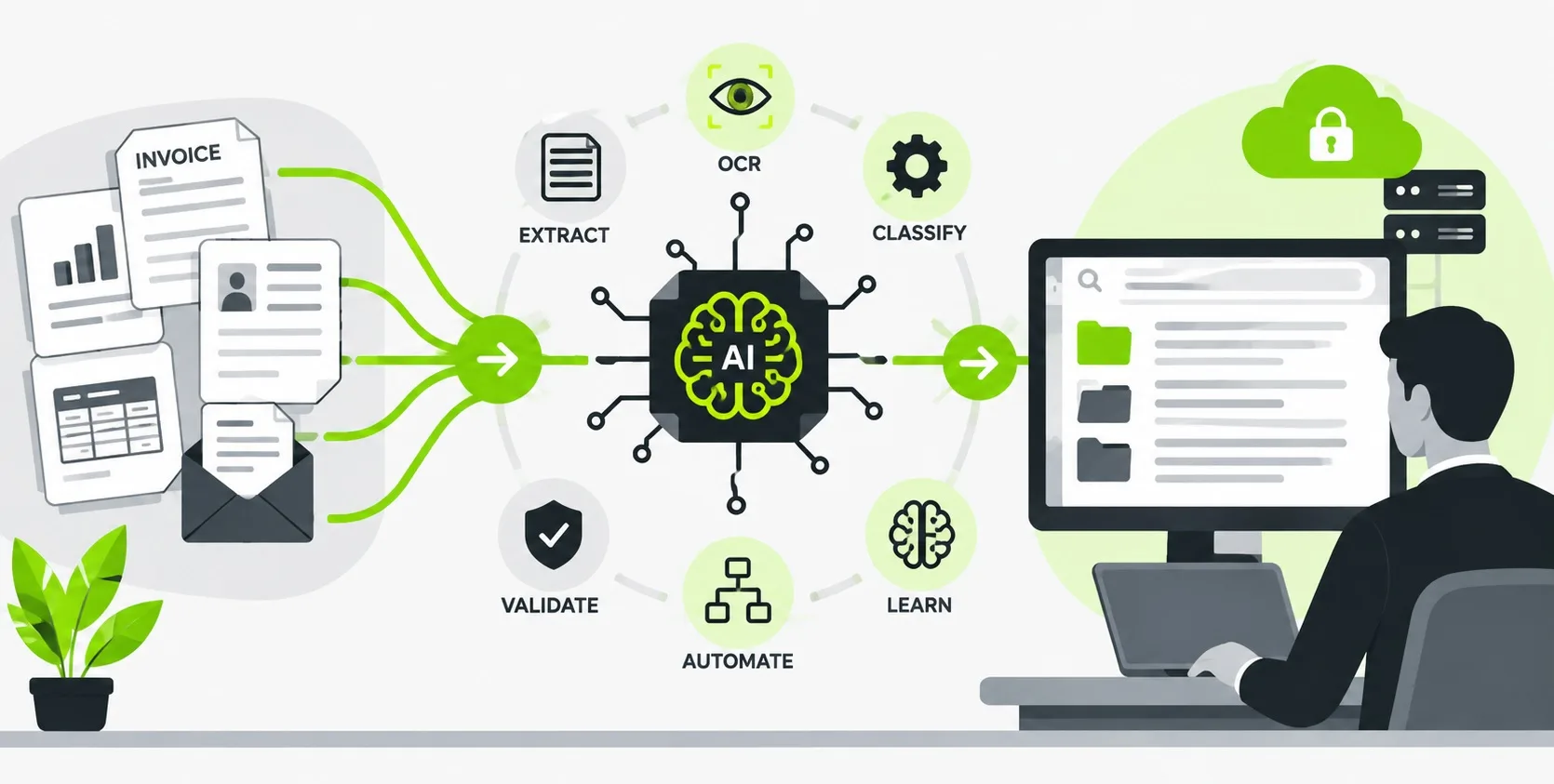
Why better document management starts with how information is organised
The answer is not simply to introduce more folders or ask employees to be more careful about naming files. Those measures may help, but they do not address the underlying challenge of managing information consistently across the business.
A more effective approach begins by considering what a document represents, how it relates to other information and what people need to do with it.
For example, a contract is not just a PDF. It may be connected to a supplier, a purchase order, a set of invoices, an approval process and a renewal date. A document management system should make it easier to understand and navigate these relationships rather than treating every file as an isolated object.
This is where metadata and indexing become valuable. Metadata is information about a document, such as its type, date, department, customer, supplier or project reference. When applied consistently, it gives people additional ways to locate information without having to remember the exact file name or folder in which it was saved.
Instead of searching through a long list of folders, an employee may be able to search by supplier, document type and date. Appropriate permissions can help ensure that the results are limited to information the employee is authorised to access.
Centralised document management can also provide a more dependable source of information. Rather than maintaining separate copies in different locations, employees can work with controlled records, supported by version management, access permissions and an audit trail where required.
The aim is not to eliminate every familiar working method overnight. It is to make the reliable way of working the easiest way of working.
Can AI make finding documents easier?
Artificial intelligence is beginning to change what people can expect from document search.
Traditional search often depends on knowing the right words, file names or metadata fields. If someone searches for a phrase that does not appear in a document, the results may be disappointing, even when the information they need is present.
AI-assisted search can offer a different experience. Depending on the technology and how it is implemented, it may help people find information by meaning rather than relying exclusively on exact keyword matches. Some tools can also extract information from documents, identify relevant passages or help users interrogate collections of business records.
Consider a simple example. A manager needs to find the terms governing the renewal of a supplier agreement. They may not remember the file name, the folder location or the exact wording used in the contract. A suitable AI-enabled document management system could help them locate the relevant agreement and identify the clauses that relate to renewal.
That could save time, but the quality of the result depends on the documents available to the system, the way they have been indexed, the permissions in place and the capabilities of the AI itself. It is important to verify information against the original record, particularly when a decision has legal, financial or operational consequences.
AI does not remove the need for sound information management. In many cases, it makes that foundation more important. A system cannot reliably retrieve information that it cannot access, distinguish between documents that have not been properly identified or resolve conflicting versions without the necessary context.
For businesses exploring AI, the sensible starting point is to establish what information they have, where it is held and how it should be governed. AI can then build on that foundation to support more intelligent retrieval and more efficient ways of working.
When is it time to consider a dedicated document management system?
Not every business needs a sophisticated document management platform. A small organisation with relatively few records and straightforward processes may be perfectly well served by a simple shared filing arrangement.
The question is whether the current approach continues to meet the organisation’s needs as its information grows and its operations become more complex.
There are some clear signs that it may be time to review the situation. Employees regularly ask colleagues to locate documents. Different departments maintain separate versions of the same records. Audit requests take longer than expected. Staff struggle to apply retention rules consistently. Important processes depend on manual checks, email reminders or individual knowledge.
These are not necessarily signs that a particular piece of software has failed. They may indicate that the organisation’s requirements have outgrown the way its information is currently managed.
A dedicated document management system can provide a structured environment for capturing, organising, retrieving, sharing and controlling business documents. Depending on the solution, it may also support workflow automation, electronic approvals, retention management, audit trails and integration with other business applications.
For organisations already using general collaboration platforms, the decision is not always a question of replacing one system with another. It may be a question of whether the existing platform provides the depth of document control, process automation and governance that the business now requires.
The important thing is to assess the real problem before choosing the technology. Start with the documents people struggle to find, the processes that take too long and the risks that are hardest to control. From there, it becomes easier to establish which capabilities would make a meaningful difference.
Document Logistix helps organisations manage business documents and the processes around them. A more structured approach can make information easier to find, support more consistent working practices and reduce the administrative effort involved in managing documents.
To explore the wider business case, read our guide to document management software costs and our article on SharePoint versus a dedicated document management system.
Where should a business start to improve document search?
Improving document management does not have to begin with a major technology project. Often, the most useful first step is to understand what is happening today.
Ask employees where they look for frequently used documents, which types of information are hardest to locate and what they do when a search fails. Speak to the teams that manage contracts, invoices, HR records and operational documentation. Each will have different requirements, and those differences matter.
It is also worth measuring the problem. Estimate how long people spend searching for information, identify processes that regularly stall because a document is missing and record how often staff need to recreate or request information that should already be available.
Then consider the wider picture. Are documents being stored consistently? Can employees distinguish current versions from superseded ones? Are access permissions appropriate? Can the organisation apply retention rules in practice? Is there a dependable audit trail where one is needed?
These questions help to turn a vague complaint about disorganised files into a practical business case for improvement.
The objective is not to create a perfect filing system. The goal is to give people confidence that the information they need can be found when they need it, that it is reliable and that it is being managed appropriately.
Operational efficiency is what makes document management a business issue rather than simply an IT concern.
Conclusion: stop treating the search for information as an unavoidable cost
Searching for documents is such an ordinary part of working life that many organisations accept the wasted time as inevitable. Employees learn where to look, who to ask and which workarounds are most likely to succeed.
But the fact that people have become accustomed to a problem does not make it harmless.
The time spent finding files, checking versions and chasing colleagues can accumulate into a significant operational cost. Poorly managed information can also make it harder to maintain control, respond to requests and demonstrate compliance.
Improved document management provides a way to address these problems at their source. By organising information consistently, improving search, controlling versions and automating appropriate processes, businesses can make everyday work simpler and more dependable.
AI offers further opportunities to improve the way people discover and use information, provided it is built on a sound foundation of accessible, well-managed records.
The starting point is a straightforward question: how much time does your organisation spend looking for information that should already be easy to find?
The answer may reveal an opportunity to improve productivity, reduce unnecessary effort and give employees more time to concentrate on work that genuinely moves the business forward.
Frequently asked questions: Document search
Why is it so difficult to find documents at work?
Documents are often spread across email, shared drives, collaboration platforms and individual computers. Inconsistent file names, duplicate copies and poorly structured folders make searching harder. As the volume of information grows, employees can spend increasing amounts of time working out where a document is stored and whether it is the correct version.
How much time do employees waste searching for documents?
The amount varies between organisations and roles. Microsoft’s 2023 Work Trend Index found that 62% of surveyed workers struggled with spending too much time searching for information during their working day. Businesses can estimate their own costs by measuring the time spent searching each day, multiplying it by the number of affected employees and calculating the annual employment cost of that time.
How can a business improve document management?
Start by understanding where documents are stored, how employees find them and which processes cause the most difficulty. Consistent naming conventions, appropriate metadata, centralised access, version control and clear permissions can all help. A dedicated document management system may be appropriate when existing arrangements no longer provide sufficient control or functionality.
What is the difference between file storage and document management?
File storage provides a place to save and access digital files. Document management goes further by helping an organisation to organise, retrieve, control and govern its documents throughout their lifecycle. Depending on the system, management can include metadata, version histories, audit trails, automated workflows and retention controls.
Can AI help employees find documents faster?
AI can support more intelligent document retrieval by helping users search by meaning, identify relevant information and interrogate document collections. The capabilities vary between solutions, and results depend on the quality and accessibility of the underlying information. AI should complement reliable document organisation, appropriate permissions and human verification rather than replace them.
Does a document management system help with GDPR compliance?
A document management system can support aspects of information governance, including access control, auditability and retention processes. However, software alone does not guarantee compliance. Organisations remain responsible for establishing appropriate policies, deciding how long personal data should be retained and ensuring that their practices meet applicable data protection requirements. The ICO provides further guidance on UK GDPR documentation and accountability.
When should a business invest in document management software?
It may be time to consider a dedicated solution when employees regularly struggle to find information, version confusion causes errors, audit preparation is difficult or document-related processes rely heavily on manual intervention. The decision should be based on the organisation’s information volumes, operational requirements, risks and potential benefits, rather than simply on the number of documents it holds.
How can I calculate the cost of poor document management?
Estimate the average time each employee spends searching for documents and related information each working day. Multiply that figure by the number of affected employees, the number of working days in a year and the average hourly employment cost. This gives an indicative estimate of the time-related cost. You can then consider additional impacts, such as duplicated work, delays, errors and compliance risks, while avoiding counting the same costs twice.