
What Is Intelligent Document Processing?
Every organisation depends on information. Invoices arrive by email, contracts are stored on shared drives, customer forms are submitted online and compliance records accumulate year after year. Yet many businesses still rely on manual processes to extract, classify and manage this information.
Intelligent Document Processing (IDP) has emerged as a solution to this information management challenge.
IDP combines artificial intelligence, machine learning, optical character recognition (OCR) and workflow automation to capture, understand and process information from documents with minimal human intervention.
Unlike traditional OCR systems that simply convert images into text, intelligent document processing interprets context, identifies document types, extracts relevant information and routes data automatically into business systems.
For UK organisations facing increasing regulatory requirements, growing document volumes and pressure to improve efficiency, IDP is becoming an essential part of digital transformation strategies.
This comprehensive guide explores how Intelligent Document Processing (IDP) is transforming business operations by combining artificial intelligence, machine learning and advanced data capture technologies. It covers the fundamentals of IDP, key business benefits, real-world use cases, document automation strategies, and the role of end-to-end process automation. Readers will also learn how IDP improves accuracy, efficiency, compliance and scalability while helping organisations to unlock greater value from unstructured business data and accelerate their digital transformation initiatives.
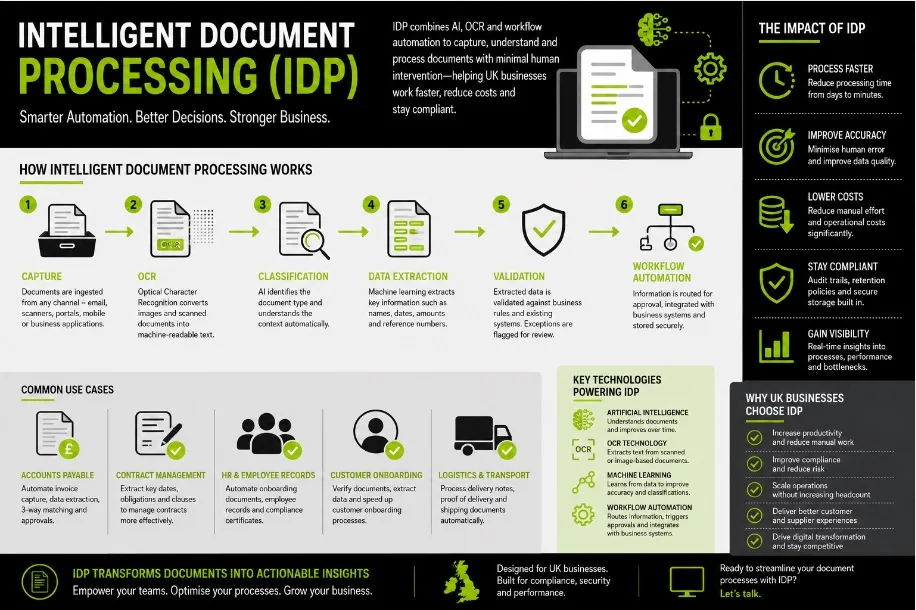
Why Intelligent Document Processing Matters
Businesses generate and receive vast amounts of information every day. Finance departments process supplier invoices. HR teams manage employee records. Customer service teams handle forms and correspondence. Legal departments review contracts and agreements.
When these business processes rely on manual data entry, organisations often experience:
- Slow processing times
- Human errors
- High operational costs
- Compliance risks
- Poor visibility into business processes
- Difficulty scaling operations
Intelligent document processing addresses these challenges by automating repetitive tasks and enabling employees to focus on higher-value work.
The result is faster decision-making, improved accuracy and greater operational efficiency.
How Intelligent Document Processing Works
Although IDP is often described as a single technology, it is actually a combination of several technologies working together.
Document Capture
The capture process begins with document ingestion.
Documents may arrive through multiple channels including:
- Email attachments
- Scanned paper documents
- PDF files
- Online forms
- Mobile devices
- Shared folders
- Business applications
The information management system automatically imports documents into a secure central repository for processing.
Optical Character Recognition (OCR)
OCR technology converts scanned documents and images into machine-readable text.
For example, a scanned supplier invoice can be transformed into digital data that can be indexed, searched, analysed and processed.
Modern OCR technology is significantly more accurate than earlier generations and can handle various document formats, layouts and languages.
Classification and Identification
Once text has been extracted, artificial intelligence identifies the document type.
The system may recognise whether a document is:
- An invoice
- A purchase order
- A contract
- A customer application form
- A delivery note
- An HR document
This document classification process happens automatically and eliminates the need for manual sorting.
Data Extraction
Machine learning models identify and extract key information from documents.
For example, for invoices, this might include:
- Supplier name
- Invoice number
- Invoice date
- VAT amount
- Purchase order reference
- Payment terms
For contracts, on the other hand, the information system may extract renewal dates, clauses and obligations.
Validation and Verification
Extracted data is validated against business rules and other installed systems.
For example, invoice values can be matched against purchase orders and supplier records to ensure accuracy.
Exceptions are flagged for human review while routine transactions proceed automatically.
Workflow Automation
Once information has been validated, workflows are triggered automatically.
Documents can be routed for approval, archived within a document management system or transferred to finance, ERP or CRM platforms.
Workflows create a seamless end-to-end process with minimal manual involvement.
Intelligent Document Processing vs Traditional OCR
Many organisations mistakenly assume OCR and IDP are the same thing.
Traditional OCR focuses on converting images into text.
Intelligent document processing goes much further.
OCR can read a document.
IDP can understand a document.
For example, traditional OCR might recognise the text on an invoice but still require an employee to identify key fields and enter information into an accounts system.
An IDP platform can identify the invoice automatically, extract the relevant information, validate it against business rules and route it through an approval workflow without human intervention.
This IDP OCR distinction is becoming increasingly important as organisations seek greater levels of automation.
The Business Benefits of Intelligent Document Processing
Increased Efficiency
Manual document processing is time-consuming.
IDP reduces administrative workloads dramatically by automating repetitive tasks that previously required significant staff involvement.
Many organisations report processing times reduced from days to minutes.
Improved Accuracy
Human error is inevitable when employees manually enter data from documents.
Automated extraction and validation significantly improve accuracy while reducing costly mistakes.
Lower Operating Costs
Reduced manual effort means organisations can process larger document volumes without increasing headcount.
Digitisation creates measurable cost savings and improved productivity.
Better Compliance
Regulated industries must maintain accurate records, audit trails and retention policies.
IDP systems support compliance by ensuring documents are processed consistently, stored securely and retained and deleted in line with GDPR requirements.
Faster Customer Service
When information can be accessed instantly, organisations can respond more quickly to customer enquiries and service requests.
Greater Visibility
Automated workflows provide real-time insight into document status, processing times and bottlenecks.
Managers gain a clearer understanding of business operations and opportunities for improvement.
Common Intelligent Document Processing Use Cases
Accounts Payable Automation
Invoice processing remains one of the most common IDP applications.
Invoices are captured automatically, data is extracted and validated, approvals are routed electronically and records are stored securely.
Businesses often achieve substantial reductions in processing costs while improving supplier relationships.
Related topic: Accounts Payable Automation Guide
Contract Management
Legal teams frequently manage large volumes of contracts.
IDP can identify contract types, extract key dates and obligations and support compliance monitoring.
Related topic: AI Contract Analysis
HR and Employee Records
Employee onboarding generates significant documentation.
IDP automates the capture and classification of employment contracts, identification documents and compliance records.
Customer Onboarding
Financial services, insurance providers and professional services firms often use IDP to automate customer onboarding processes.
Documents can be verified and processed significantly faster than traditional methods allow.
Logistics and Transport
Delivery notes, proof-of-delivery documents and shipping records can be processed automatically to reduce administrative workloads and improving operational visibility.
Intelligent Document Processing and AI
Artificial intelligence is the driving force behind modern IDP solutions.
Machine learning algorithms continuously improve their understanding of documents over time.
As the system processes more invoices, contracts and forms, its accuracy increases.
Generative AI is also beginning to influence document processing by enabling:
- Natural language querying
- Intelligent document summarisation
- Contract analysis
- Automated correspondence generation
- Enhanced knowledge retrieval
The evolution of AI represents the next stage in document automation.
Intelligent Document Processing and Compliance
Compliance remains a major concern for UK organisations.
Businesses must meet requirements under legislation and frameworks such as:
- UK GDPR
- Data Protection Act 2018
- ISO 27001
- Financial Conduct Authority regulations
- NHS information governance requirements
- Industry-specific retention obligations
An intelligent document processing platform supports compliance by maintaining audit trails, enforcing retention schedules and ensuring secure document storage.
Built-in compliance measures reduce risk while improving governance.
How to Choose an Intelligent Document Processing Solution
Not all platforms offer the same capabilities.
When evaluating solutions, organisations should consider:
Accuracy
Look for high extraction accuracy across different document types.
Integration
The platform should integrate with existing systems including ERP, CRM and document management solutions.
Scalability
Choose a solution capable of handling future growth and increasing document volumes.
Security
Strong security controls, encryption and role-based permissions are essential.
Workflow Automation
The greatest value often comes from automating entire processes rather than simply extracting data.
Compliance Features
Audit trails, retention management and governance controls are particularly important for regulated industries.
The Future of Intelligent Document Processing
The market for intelligent document processing continues to grow rapidly.
As artificial intelligence technologies mature, organisations can expect:
- Greater automation
- Improved extraction accuracy
- Enhanced analytics
- Better integration with business systems
- More sophisticated AI-driven insights
Businesses that adopt these technologies early are likely to gain significant operational advantages over competitors still reliant on manual processes.
IDP Today: Conclusion
Intelligent document processing is transforming how organisations manage information.
By combining OCR, artificial intelligence and workflow automation, businesses can reduce costs, improve accuracy and create more efficient operations.
For UK organisations facing increasing compliance requirements and growing document volumes, IDP offers a practical path towards digital transformation.
Whether the goal is automating invoice processing, managing contracts more effectively or improving records management, intelligent document processing provides the foundation for faster, smarter and more secure information management.
As artificial intelligence continues to evolve, IDP is set to become a core component of modern document management and business automation strategies.
Intelligent Document Processing (IDP): The Complete Guide for UK Businesses
Learn how Intelligent Document Processing (IDP) uses AI, OCR and automation to streamline document workflows, improve compliance and reduce costs for UK organisations.
See Intelligent Document Processing in Action >>>
Document Logistix has been helping organisations automate document-centric processes for thirty years, by combining intelligent document management, workflow automation and IDP technologies. Our expertise in capturing, extracting and processing business-critical information enables organisations to reduce manual effort, improve accuracy, accelerate decision-making and achieve measurable digital transformation outcomes. See for yourself and get in touch to discover how IDP could help your organisation.

Creating End-to-End Automation Through Intelligent Document Workflows
Intelligent Document Processing (IDP) delivers its greatest value when it forms part of a wider end-to-end process automation strategy. While many organisations initially adopt IDP to automate document capture and data extraction, the real transformation occurs when that information automatically triggers and supports downstream business processes.
For example, when an invoice is received, an IDP solution can classify the document, extract key data, validate information against business rules, and automatically route it into an accounts payable workflow. Approvals can be assigned to the appropriate stakeholders, exceptions flagged for review, and approved invoices posted directly into finance or ERP systems without manual intervention.
This seamless flow of information eliminates repetitive administrative tasks, reduces processing delays, and minimises the risk of human error. Employees are no longer required to manually transfer data between systems or chase documents through multiple approval stages.
By combining Intelligent Document Processing with workflow automation, organisations create connected, data-driven processes that improve operational efficiency, increase visibility, strengthen compliance, and accelerate decision-making. The result is a more agile business environment where information moves automatically from document receipt to final action, enabling teams to focus on higher-value activities while supporting scalable business growth.
IDP and Business Growth: Building a Scalable Document Processing Strategy for Future Growth
As organisations expand, document complexity increases alongside transaction volumes, regulatory requirements and customer expectations. A scalable Intelligent Document Processing strategy enables businesses to manage growth without proportionally increasing administrative costs or staffing requirements.
Modern AI-powered document processing solutions can adapt to changing document formats, support multiple departments and accommodate new business processes as requirements evolve. This flexibility is particularly valuable for organisations managing supplier invoices, customer correspondence, contracts, compliance records and operational documentation across multiple locations.
Security and governance also play an essential role in long-term success. Businesses need visibility into how information is captured, processed and stored while maintaining compliance with industry regulations and data protection requirements. By implementing a scalable document intelligence framework, organisations gain a foundation for continuous process improvement, operational resilience and sustainable growth in an increasingly digital business environment.
Frequently Asked Questions About Intelligent Document Processing
What is Intelligent Document Processing (IDP)?
Intelligent Document Processing (IDP) is a technology that combines artificial intelligence, machine learning, optical character recognition (OCR) and workflow automation to capture, classify, extract and process information from documents automatically. IDP enables organisations to reduce manual data entry, improve accuracy and streamline business processes.
How does Intelligent Document Processing differ from OCR?
OCR converts scanned documents and images into machine-readable text. Intelligent Document Processing goes much further by understanding document content, recognising document types, extracting relevant data and automatically routing information through business workflows. In simple terms, OCR reads documents while IDP understands and processes them.
What types of documents can IDP process?
Most modern IDP solutions can process a wide range of document types including invoices, purchase orders, contracts, application forms, delivery notes, HR records, customer correspondence, medical records and compliance documents.
What are the benefits of Intelligent Document Processing?
The main benefits include faster document processing, reduced administrative costs, improved data accuracy, enhanced compliance, greater operational efficiency and better visibility into business processes. Many organisations also experience improved customer service and faster decision-making.
Can Intelligent Document Processing improve compliance?
Yes. IDP solutions can support compliance by creating audit trails, enforcing document retention policies, maintaining version control and ensuring records are stored securely. This is particularly valuable for organisations operating in highly regulated sectors such as healthcare, finance, education and the public sector.
Is Intelligent Document Processing suitable for small and medium-sized businesses?
Absolutely. While large enterprises were early adopters, cloud-based solutions have made Intelligent Document Processing accessible to small and medium-sized businesses. Organisations processing invoices, customer forms or compliance documents can often achieve significant efficiency gains regardless of size.
What industries benefit most from Intelligent Document Processing?
Industries that handle high volumes of documentation often see the greatest return on investment. These include finance, healthcare, legal services, manufacturing, logistics, education, local government and professional services.
How accurate is Intelligent Document Processing?
Accuracy varies depending on document quality and the technology used. Modern AI-powered IDP solutions can achieve very high levels of accuracy, often exceeding manual processing. Many platforms also improve over time through machine learning and user feedback.
What is the return on investment for Intelligent Document Processing?
Return on investment is typically achieved through reduced labour costs, faster processing times, fewer errors and improved compliance. Organisations often see measurable savings by automating invoice processing, document classification and data extraction tasks that would otherwise require manual effort.
How does Intelligent Document Processing support accounts payable automation?
IDP can automatically capture invoices, extract key information, validate data against purchase orders, route approvals and archive records. Automation reduces processing times, minimises errors and helps finance teams manage increasing invoice volumes more efficiently.
Is Intelligent Document Processing secure?
Most enterprise-grade IDP platforms include robust security features such as encryption, access controls, audit logs and secure cloud hosting. Organisations should ensure any solution they choose aligns with their security policies and regulatory requirements.
What should businesses look for when choosing an IDP solution?
Key considerations include accuracy, ease of integration, scalability, workflow automation capabilities, security features, compliance support and vendor expertise. Businesses should also consider how well the solution integrates with legacy document management, ERP and CRM systems.
Related articles
Read our latest article on the advances of AI in document management