
This article explores the key document management trends for 2026 that every organisation should be aware of.
Beyond the Inbox: Document Management Trends 2026
In 2026, document management (DM) is moving beyond file storage. What was once a digital filing cabinet is now an information ecosystem that connects people, processes and decisions in real time.
Modern document management systems use AI, machine learning and automation to interpret, categorise and act on content in real time – and determine how organisations handle their most valuable asset: information.
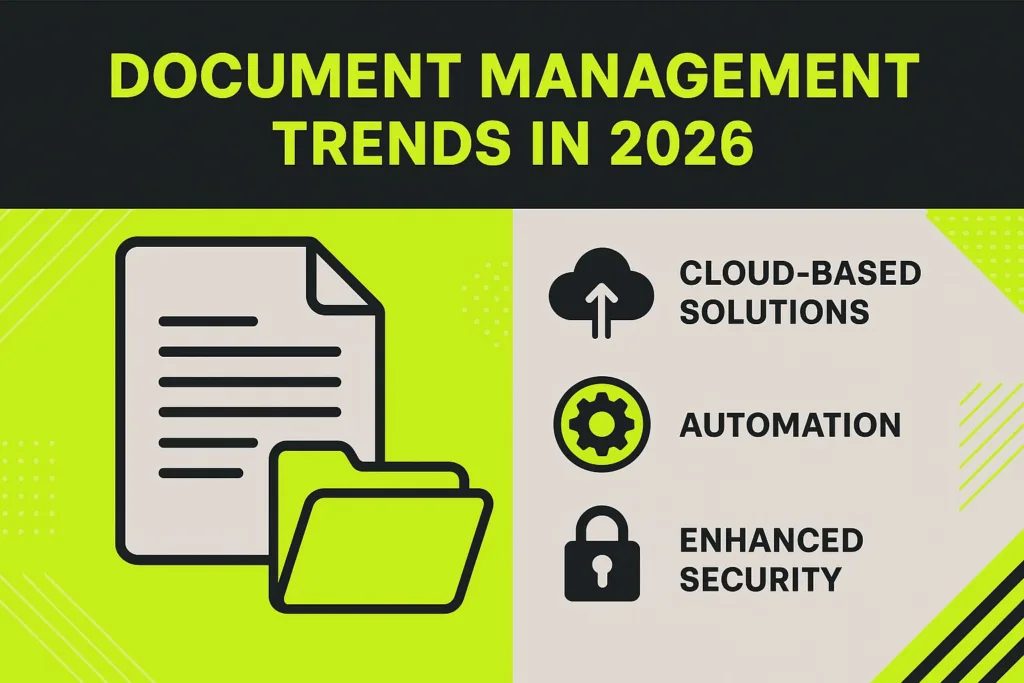
From Storage to Smart Systems
Just a few years ago, document management meant scanning paper archives, setting up folders and ensuring compliance. Today it’s about smart workflows and contextual insight.
Leading DM platforms can now:
- Automatically extract metadata and classify documents.
- Self-route approval workflows based on context.
- Proactively flag compliance issues before they escalate.
The shift is clear – information now moves, interacts and creates value, and does not just sit in storage.
Read more about:
Document Lifecycle Management
Automation Is the New Normal
In 2026, automation is the major feature on the document management landscape. Intelligent Document Processing (IDP) powered by natural language AI is reducing manual work across industries.
Tasks like data entry, invoice validation and contract versioning are now automated, which frees up teams for higher value work.
Key automation trends:
- No-code workflow builders allow non-technical users to automate processes in minutes.
- AI-assisted decision-making standardises tasks and ensures full audit trails.
- Accessibility-first automation closes the gap between IT and operations.
Industries like financial services, logistics and healthcare are leading this change and gaining speed, accuracy and compliance confidence.
Smarter, Not Stricter: The Future of Security and Compliance
Security is important but the approach is evolving. In 2026 organisations want intelligent safeguards, not rigid restrictions.
Emerging trends:
- Adaptive security models use behavioural analytics to detect anomalies.
- Dynamic compliance monitoring integrates into workflows.
- Regulatory alignment with GDPR updates and new state-level privacy laws.
The result is a more confident, less stressful approach to governance and risk management, by blending protection with productivity.
Seamless Integration and Connected Experiences
Modern document management thrives on interoperability. In 2026 your document management system must connect seamlessly with your CRM, ERP and HR tools.
What customers expect:
- Real-time access within everyday apps (approve contracts, retrieve records, share updates).
- Cloud-native APIs for cross-platform data flow.
- Mobile-first access, for field teams to work offline or on the go.
Document management is no longer a standalone system; it’s a connected, invisible layer of digital transformation.
From Efficiency to Intelligence
Efficiency has always been the promise of document management, but 2026 brings a new era: intelligence.
AI-driven analytics are turning document repositories into insight engines:
- Analyse thousands of contracts for supplier performance trends.
- Identify negotiation bottlenecks through pattern detection.
- Summarise and extract key clauses or deadlines automatically.
These insights help organisations to refine procurement, compliance and customer strategies, to unlock the full potential of their document data.
Sustainable Document Management
Sustainability is shaping technology choices everywhere, and document management is no exception.
Digital workflows reduce paper waste, but forward-thinking companies go further and use DM platforms to:
- Optimise cloud storage and eliminate data duplication.
- Track environmental metrics like printing or courier usage.
- Automate lifecycle management to delete obsolete files.
Smart document management supports both operational efficiency and environmental responsibility.
Human-Centric Design: Simplicity Wins
No matter how advanced the technology, success depends on user experience.
Modern DM systems now feature:
- Clean, intuitive dashboards.
- Natural language search (e.g. “show me the latest version of the DLX contract”).
- Drag-and-drop workflow builders like Document Logistix’s Dynamic Workflow Designer.
When employees actually enjoy using the system, adoption soars and the benefits multiply.

Looking Ahead to 2026 and Beyond
The direction of document management is clear: Smarter. More connected. More human.
Expect:
- More automation and intelligence.
- More proactive compliance and security.
- More integration and insight.
Document management isn’t about finding files – it’s about enabling people. At Document Logistix we help you to future-proof with our flexible, secure and intelligent document solutions.
Contact Document Logistix to see how our next generation platform can help your business adopt the 2026 document management trends: automation, insight and simplicity included. See Document Manager in action ….
FAQs About Document Management Trends in 2026
Q1: What role will AI play in document management in 2026?
A: AI will further streamline document management by automating tasks like data extraction, classification and analysis, to improve efficiency and reduce errors.
Q2: Is cloud-based document management secure?
A: Yes, cloud-based DMS providers are continually improving security features like encryption, multi-factor authentication and compliance tools to ensure data protection.
Q3: Why is going paperless important for businesses?
A: Adopting paperless workflows reduces environmental impact, lowers costs, speeds up document processing and enhances collaboration.
Q4: What mobile features should a document management system have in 2026?
A: A mobile-first DMS should offer authentication, secure mobile access, full document editing capabilities and seamless integration with cloud storage.
By staying informed about these trends, businesses can optimise their document management processes and stay competitive in the rapidly evolving digital landscape of 2026.
Six Document Management Trends of 2025: What Did We See?
The key document management advances that every organisation should be aware of.
What Direction did Document Management Take in the Past Twelve Months
1. AI-Powered Document Management
Artificial intelligence (AI) continued to transform document management by automating tasks like data entry, classification and content analysis. AI-based document processing tools significantly reduce human error, streamline workflows and help organisations to extract valuable insights from their data.
Natural Language Processing (NLP), a subset of AI, is enabling more intuitive search functions to help users find the exact document or piece of information they need. This trend is saving businesses time and improving decision-making processes by providing instant access to relevant data.
Benefits of AI in Document Management:
- Faster and more accurate data extraction
- Advanced search capabilities
- Automation of repetitive tasks
- Improved compliance with regulations
2. Increased Focus on Data Privacy and Compliance
With growing concerns about data breaches and stringent regulations such as GDPR, CCPA, and industry-specific standards, data privacy remains a top priority for document management systems. Companies are investing in advanced encryption techniques, user access controls and audit trails to ensure data integrity and compliance with global and regional laws.
Moreover, document management platforms feature built-in compliance tools that automatically monitor and enforce regulations across stored documents. Businesses that are adopting these tools mitigate the risk of non-compliance penalties and ensure the privacy of sensitive information.
Key Compliance Features to Look For:
- End-to-end encryption
- Automated compliance monitoring
- Role-based access controls
- Secure collaboration and sharing
3. Cloud-Based Document Management Solutions
Cloud-based document management systems continue to offer businesses scalability, cost-effectiveness and remote accessibility. As more companies adopt hybrid or remote work models, the cloud is enabling employees to access documents securely from any location.
Cloud solutions also enhance collaboration by enabling teams to work on the same document simultaneously, regardless of their location.
Advantages of Cloud Document Management:
- Scalable storage and processing power
- Remote access and real-time collaboration
- Reduced IT infrastructure costs
- Regular updates and enhanced security features
Benefits of On-premises Document Management
The demand and need for on-premises document management remains strong and is becoming stronger in some industries and sectors. On-premises solutions provide several benefits:
- Control
Full control over the system, data and infrastructure. - Security
Enhanced data protection as sensitive information is kept in-house, reducing risks of third-party breaches. - Compliance
Easier to meet industry-specific regulations, as businesses can implement and monitor their own security protocols. - Reliability
No dependence on external networks or internet connections, ensuring constant access to documents. - Cost Predictability
Initial upfront costs with fewer ongoing subscription fees, making long-term budgeting more predictable.
An on-premises DMS is ideal for companies with strict data security and compliance needs, for example in the financial and healthcare sectors.
4. Sustainability and Paperless Workflows
As businesses aim to reduce their environmental footprint, paperless workflows has become the norm. Digital document management plays a pivotal role in minimising the use of paper, ink and physical storage. Organisations that adopt digital-first strategies not only lower costs but also appeal to eco-conscious customers and stakeholders..
Key Benefits of Paperless Workflows:
- Reduced environmental impact
- Cost savings from reduced paper and printing
- Faster document processing and approval times
- Enhanced remote and digital collaboration
5. Advanced Analytics and Business Intelligence
In 2025, document management systems increasingly integrated with business intelligence (BI) tools to provide advanced analytics on document use, workflow bottlenecks and employee productivity. By analysing patterns in document access and handling, businesses are gaining actionable insights to optimise their processes.
Benefits of Document Management Analytics:
- Improved process efficiency
- Better resource allocation
- Predictive insights for proactive management
- Enhanced visibility into document workflows
6. Integration with Other Business Tools
It has become mission-critical to integrate document management systems with other essential business tools like CRM, ERP, HR and project management platforms. These integrations streamline workflows by enabling data and documents to flow seamlessly across different platforms without the need for manual intervention, and to eliminate data silos.
Benefits of DMS Integration:
- Seamless data sharing across platforms
- Automated workflows and document routing
- Improved collaboration across departments
- Centralised document storage and management
Conclusion
As we leave 2025 behind, businesses must adapt to the latest document management trends to maximise efficiency and/or competitiveness.
From AI-driven automation and cloud-based solutions to paperless workflows, these trends will continue to reshape how organisations handle documents to enhance efficiency, compliance and security. By embracing these innovations, companies can future-proof their document management strategies and ensure they are prepared for the challenges of tomorrow.
Related Articles
A Complete Guide to Digital Document Management
Document Management in AP and HR
Document Logistix Win Company of the Year and Records Management Product of the Year Awards